Best Dry Dog Food for Pugs: Comparing Labels
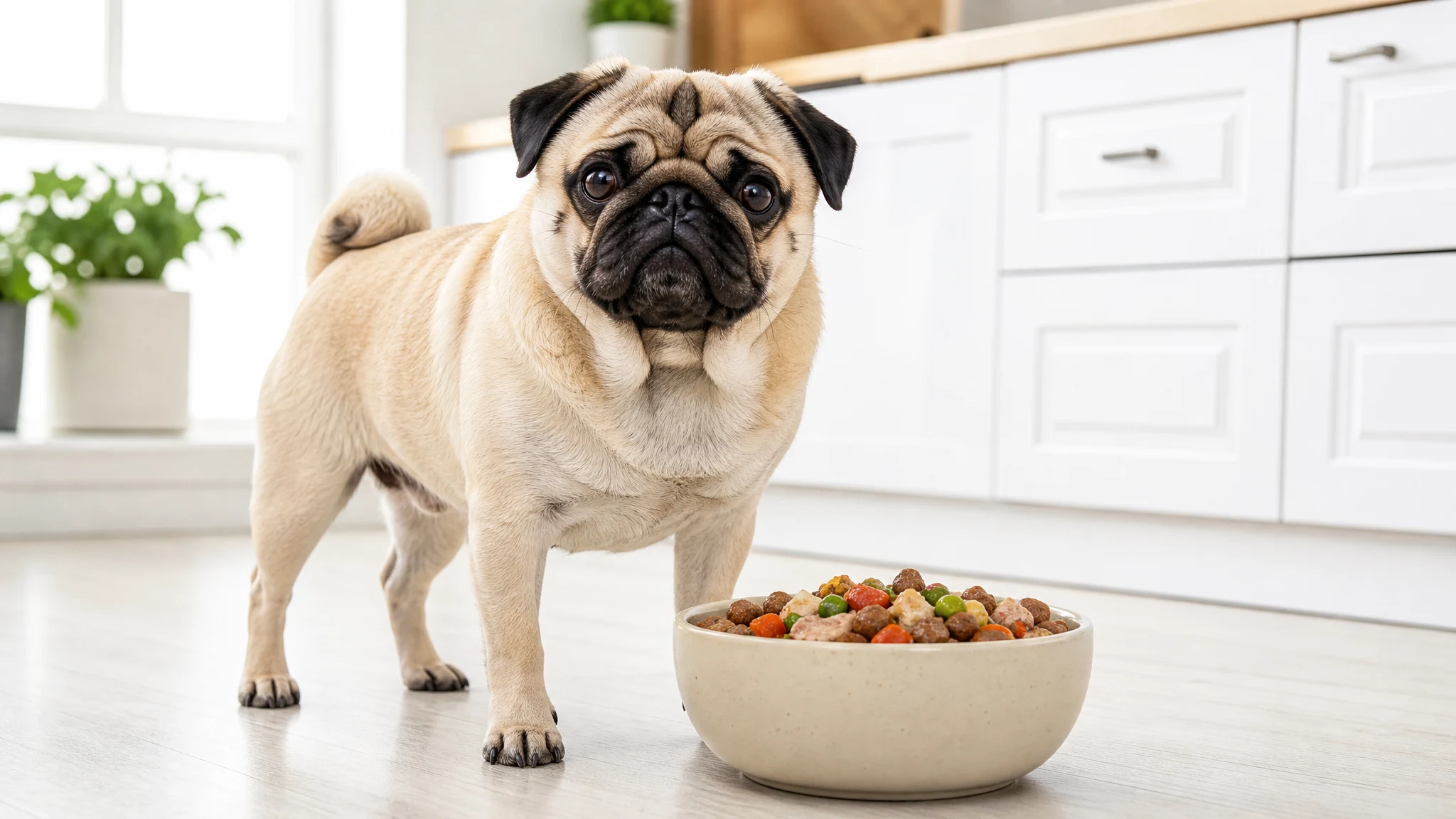
General nutrition information compiled from product labels and published sources, not veterinary advice. Your veterinarian is the right person to choose a diet for your dog, especially one with a health condition.
Every bag of kibble says it is right for your dog. The label is where you can check. This guide shows you how to read and compare the labels on dry foods, so you can build your own shortlist of the best dry dog food for Pugs and then take it to your veterinarian.
One note on method. We compared label data published on each brand's own product page. We did not run feeding trials or taste tests, and we are not ranking foods by how a dog responds to them.
Why Pugs Need a Closer Look at Labels
The Orvis Pug breed page gives an average adult weight of 14 to 18 pounds and a life expectancy of 13 to 15 years. It also lists obesity among the common Pug health issues. Because Pugs are small, a few extra kibbles a day make up a large share of what they need.
A Texas A&M College of Veterinary Medicine press release from June 16, 2026 describes an ongoing clinical trial in short-muzzled dogs, including a Pug. Dogs that reached an ideal weight showed improvements. The trial is still running, so treat it as early information. It does suggest that calorie awareness matters for this breed.
A food label cannot tell you what your individual dog needs. Your veterinarian decides that. The label can tell you what the maker states about the food, and that is what we compare below.
Materials You Need
- The bag or the brand's product page for each food you are considering
- A notepad or spreadsheet with one row per food
- Your dog's current weight, age and body condition, ideally confirmed at a recent vet visit
- A kitchen measuring cup, if you plan to follow cup-based feeding guides
- About 20 minutes
Step-by-Step: How to Compare Dry Food Labels
Step 1: Match the life stage
Find the AAFCO nutritional adequacy statement. It is usually a small paragraph near the ingredient list. It says whether the food is formulated for growth, maintenance or all life stages. A Pug puppy and a 10-year-old Pug are different cases, so start here.
Also note how the statement was backed. Some foods say they were "formulated to meet" AAFCO nutrient profiles. Others say "animal feeding tests using AAFCO procedures substantiate" the claim. Both are legitimate statements. They are different methods, and you should record which one the label uses.
Step 2: Record calories per cup
Calories matter more than almost any other number for a breed prone to obesity. Look for kcal per cup, usually in the "calorie content" line. Write down the exact figure. A food with more calories per cup means a smaller portion for the same energy.
Step 3: Read the guaranteed analysis correctly
The guaranteed analysis lists minimum crude protein and fat and maximum fiber. These are guarantees, not exact amounts. Some pages, such as the Hill's Science Diet pages, instead show an average nutrient table on a dry matter basis. Dry matter numbers remove water, so they run higher than as-fed minimums. Do not put the two kinds of numbers side by side as if they were the same measure.
Step 4: Look at the first five ingredients
Ingredients are listed by weight before cooking. The first five give a rough picture of what the food is built from. Note whether the first ingredient is a named meat, a meal or a grain, and whether by-product meals appear. Ingredient position alone does not tell you whether a food is good or bad. It tells you what the recipe is made of.
Step 5: Check the feeding guide
Treat the feeding table as a starting point. It is a manufacturer's estimate for an average dog of that weight. Hill's, for example, tells owners to adjust amounts to maintain optimal weight and to ask a veterinarian if unsure. VICTOR says its chart is a guide and advises adjusting to maintain good body condition.
Step 6: Check kibble size, but only if the brand states it
Pugs have short, flat faces. Kibble shape may matter for how easily a dog picks it up. Royal Canin describes its Pug Adult kibble as cloverleaf shaped and its Pug Puppy kibble as shaped for the Pug's short, square muzzle. Hill's describes its Adult 11+ Small & Mini food as nibble size. Most pages give no dimensions, so check with the brand if size matters to you.
Step 7: Build your shortlist
Fill in a row for each food. The table below shows what that looks like for dry foods whose pages we could read.
Label Comparison of Dry Foods
| Food | AAFCO life stage | Protein / fat | Calories per cup | First ingredients |
|---|---|---|---|---|
| Royal Canin Pug Puppy | Growth | 27% min / 16% min | 369 kcal | Chicken by-product meal, brewers rice, corn, chicken fat, wheat gluten |
| Royal Canin Pug Adult | Maintenance | 23% min / 14% min | 315 kcal | Brewers rice, brown rice, oat groats, chicken by-product meal, corn |
| VICTOR Hi-Pro Plus Small & Medium Breed Puppy | All life stages (except growth of large dogs) | 30% min / 18% min | 383 kcal | Beef, chicken, beef meal, chicken meal, whole grain sorghum |
| VICTOR Hi-Pro Plus Small Breed Adult | All life stages (except growth of large dogs) | 30% min / 14% min | 360 kcal | Beef, chicken meal, beef meal, brown rice, whole grain millet |
| Hill's Science Diet Puppy Small & Mini | Growth (feeding tests) | 28.9% / 19.7% (dry matter averages) | 418 kcal | Chicken, whole grain oats, brown rice, chicken meal, chicken fat |
| Hill's Science Diet Adult Perfect Weight Small & Mini | Adult maintenance (feeding tests) | 28.8% / 11.2% (dry matter averages) | 298 kcal | Chicken, cracked pearled barley, brown rice, pea fiber, corn protein meal |
| Hill's Science Diet Adult 11+ Small & Mini | Adult maintenance (feeding tests) | 22.5% / 17.9% (dry matter averages) | 378 kcal | Chicken, brown rice, brewers rice, whole grain wheat, chicken fat |
All seven foods are listed by their makers as not grain-free. The Hill's protein and fat figures are dry matter averages, so they are not directly comparable to the Royal Canin and VICTOR guaranteed minimums.
What the Comparison Shows
The calorie spread is wide. The Hill's Perfect Weight food lists 298 kcal per cup, while the Hill's puppy food lists 418. A cup of one is not a cup of the other. If you switch foods, do not carry the old cup measurement over.
The Royal Canin Pug Adult lists 315 kcal per cup, near the lower end of this group. The VICTOR adult food lists 360. It also carries an all life stages statement, which covers growth as well as maintenance, so it is not an adult-only formula.
The ingredient lists differ in style. Royal Canin leads with rice, oats and by-product meal. VICTOR leads with beef and chicken. Hill's leads with chicken and whole grains. None of this makes one food right for every Pug.
For a longer side-by-side look that includes more formats, see the best dog food for Pugs compared label by label.
Tips and Common Mistakes to Avoid
- Do not compare mixed bases. Dry matter averages and as-fed minimums are different measures.
- Do not choose on the front of the bag. Photos, breed names and words like "premium" are marketing. The back panel holds the label data.
- Do not skip calories. Two bags with similar protein can differ a lot in energy per cup.
- Do not follow the table blindly. The feeding guide is a starting point. Watch your dog's waist and ribs, and adjust with your vet.
- Do not read the label as a medical claim. A food is not a treatment for hip dysplasia, breathing trouble, allergies or heart disease. If your Pug has a health condition, your veterinarian decides the diet.
- Do not switch all at once. Ask your vet how to transition, since sudden changes can upset a dog's stomach.
A Note on the FDA and Grain-Free Diets
The FDA has an investigation page on a possible link between certain diets and canine dilated cardiomyopathy (DCM). Its latest update is dated December 23, 2022, and the agency says it will not release further public updates until there is meaningful new scientific information. If you are weighing diet types, ask your veterinarian about the current picture. The FDA page is linked in the sources below.
Expected Results
A careful label comparison may leave you with a short list of two or three foods that fit your dog's life stage and calorie needs. It may also make portion planning easier, since you will know the calories per cup before you pour.
It will not tell you how your dog will do on a food, whether your dog will like it, or whether it suits any health condition. Your veterinarian can help confirm the choice, and a body condition check after several weeks may show whether the portion is working.
Missing Information
Some details are not published on the pages we could read. Kibble dimensions are not stated for most of these foods. Hill's does not list guaranteed minimums for protein and fat on the pages we reviewed. For anything missing, check with the brand directly. The Pug breed information here comes from the Orvis Pug breed page, a secondary source, so confirm breed details with the American Kennel Club or the Pug Dog Club of America.
Sources
- Royal Canin US: Pug Puppy Dry Dog Food
- Royal Canin US: Pug Adult Dry Dog Food
- Hill's Pet: Science Diet Puppy Small & Mini
- Hill's Pet: Science Diet Adult Perfect Weight Small & Mini
- Hill's Pet: Science Diet Adult 11+ Small & Mini
- VICTOR: Hi-Pro Plus Small & Medium Breed Puppy
- VICTOR: Hi-Pro Plus Small Breed Adult
- Orvis: Pug breed page
- Texas A&M College of Veterinary Medicine: press release, June 16, 2026
- FDA CVM: Investigation into Potential Link between Certain Diets and Canine Dilated Cardiomyopathy