Best Puppy Food for Pug Puppies
General nutrition information compiled from product labels and published sources, not veterinary advice. Your veterinarian is the right person to choose a diet for your dog, especially one with a health condition.
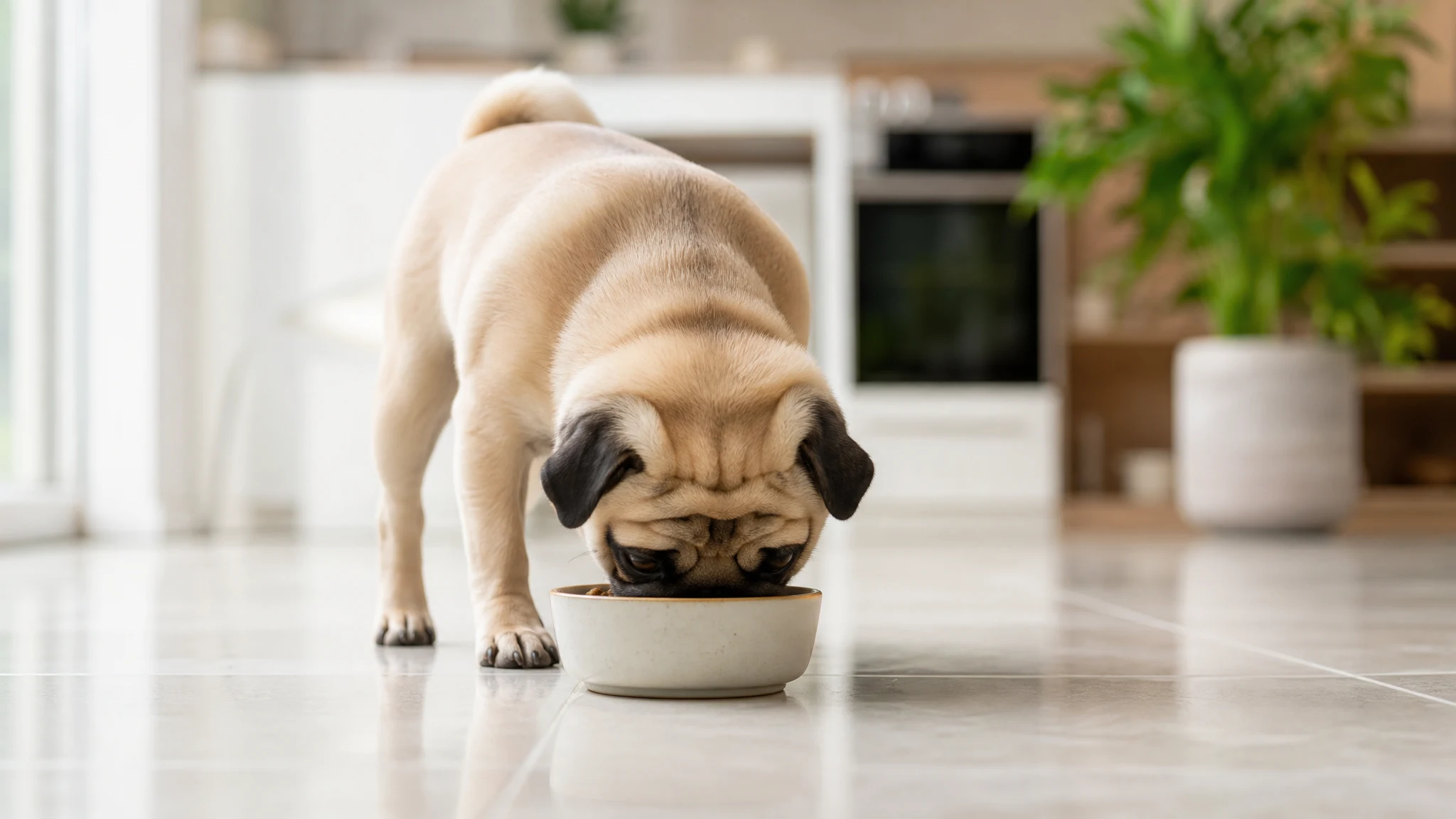
Choosing pug puppy food means reading small print. Pugs are compact dogs, and the Orvis Pug breed page gives an average adult weight of 14 to 18 pounds. Pug puppies eat small amounts, so every cup counts toward calories and nutrition.
This guide covers how to judge the best puppy food for pugs by reading labels. It compares the growth-ready foods we have label data for, flags marketing to be wary of, and explains where to buy.
How we compared these foods
We compared label data published on each brand's own product page: the AAFCO statement, ingredient order, guaranteed analysis, calories and feeding guide notes. We did not run feeding trials or taste tests, and we did not feed any of these foods to dogs.
That means this page cannot tell you which food a puppy will like, or how it will do in your home. It can help you narrow the list and ask better questions of your veterinarian.
We list no prices, because none were verified. Price is something to check on each brand's page.
What to look for in the best food for a Pug puppy
1. A growth-ready AAFCO statement
Start with the small print, not the front of the bag. A puppy food should carry a statement that it meets the AAFCO Dog Food Nutrient Profiles for growth, or for all life stages. A statement that says only "maintenance" is for adult dogs.
Some statements add an exception: "except for growth of large size dogs (70 lb. or more as an adult)." A Pug at 14 to 18 pounds is far from that size, so the exception does not matter for this breed. Large-breed puppy formulas are not something a Pug owner needs to chase.
2. Ingredients you can read
Ingredients are listed by weight before cooking, so the first five tell you the most. Look for named ingredients such as "chicken" or "beef meal" rather than vague terms. A "by-product meal" is not automatically bad, but it is a less specific label, so know what you are buying.
Ingredient order is a clue, not a score. A food is not better because it lists a meat first. Water-heavy foods and dry foods weigh ingredients differently.
3. Guaranteed analysis, read carefully
The guaranteed analysis gives minimum protein and fat and maximum fiber. These are minimums and maximums, not exact amounts. Compare them on the same basis. Some brands publish an "average" dry matter table instead, and those numbers are not directly comparable to as-fed minimums.
4. Calories per cup
For a breed where the Orvis Pug page lists obesity among common health issues, calories matter. Two foods that look alike can differ by 100 kcal per cup. A small difference in the scoop adds up quickly in a dog this size.
5. Kibble shape and size
Pugs have short, square muzzles. Royal Canin says its Pug puppy kibble is custom shaped for that muzzle, though its page gives no dimensions. For every other food here, kibble size is not stated, so check with the brand if it matters to you.
6. A feeding guide you can follow
A feeding guide is a starting point, not a rule. Look for a food whose guide matches your puppy's age and expected adult weight, and plan to adjust with your veterinarian.
Key features to compare
The table shows label data from each brand's product page. Where a number was not given in that form, it says so.
| Food | Form | AAFCO coverage | First ingredients | Calories |
|---|---|---|---|---|
| Royal Canin Pug Puppy | Dry | Growth, including large-size dogs | Chicken by-product meal, brewers rice, corn, chicken fat, wheat gluten | 369 kcal ME per cup |
| Hill's Science Diet Puppy Small & Mini Chicken & Brown Rice | Dry | Growth (AAFCO feeding tests) | Chicken, whole grain oats, brown rice, chicken meal, chicken fat | 418 kcal per cup |
| VICTOR Hi-Pro Plus Small & Medium Breed Puppy | Dry | All life stages, except large-size growth | Beef, chicken, beef meal, chicken meal, whole grain sorghum | 383 kcal per cup |
| Freshpet Small Dog Bite Size Chicken | Fresh | All life stages, except large-size growth | Chicken, chicken liver, carrots, cranberries, eggs | 267 kcal per cup |
| JustFoodForDogs Pantry Fresh Chicken & Rice | Moist, shelf-stable | All life stages, including large-size growth | Chicken breast, chicken thighs, chicken liver, long-grain white rice, kale | 387.5 kcal ME per 12.5 oz pack |
Foods labeled only for adult or senior maintenance are left out, because they are not made for growth.
Top picks by type of food
We cannot rank these by price, since no verified prices are available. Instead, here are the options grouped by what each one offers on its label. Check each brand's page for current cost and availability.
Breed-specific dry food: Royal Canin Pug Puppy
This is the only Pug-specific puppy formula in our data. Royal Canin's page says it is for purebred Pugs from 8 weeks to 10 months, and it meets AAFCO growth levels.
The guaranteed analysis lists minimum protein of 27 percent, minimum fat of 16 percent and maximum fiber of 3.9 percent. The first five ingredients are chicken by-product meal, brewers rice, corn, chicken fat and wheat gluten. It is not grain free.
The feeding table runs by puppy age, from 2 to 10 months, and by target adult weight of 13, 18 or 22 pounds. As one example from the table, a 2-month-old with a 13 pound target adult weight is listed at 1 1/8 cups (105 grams) per day.
Worth knowing: the formula leans on by-product meal and grains. If those are a concern for your puppy, talk to your veterinarian.
Small-breed dry food backed by feeding tests: Hill's Science Diet
Hill's Puppy Small & Mini Chicken & Brown Rice Recipe is for puppies up to one year. Its AAFCO statement says feeding tests using AAFCO procedures support complete and balanced nutrition for growth.
Chicken is the first ingredient, followed by whole grain oats, brown rice, chicken meal and chicken fat. At 418 kcal per cup, it is the most calorie-dense food in our table, so measure carefully.
The page publishes only an average nutrient table on a dry matter basis (protein 28.9 percent, fat 19.7 percent, crude fiber 2.3 percent). We found no guaranteed minimums in that form, so do not compare those figures directly with the other foods. The page says to adjust amounts to maintain optimal weight and to ask your veterinarian if unsure.
Higher-protein dry food: VICTOR Hi-Pro Plus
VICTOR Hi-Pro Plus Small & Medium Breed Puppy meets AAFCO levels for all life stages, except growth of large-size dogs. That wording covers a Pug puppy.
The table lists 30 percent minimum protein, 18 percent minimum fat and 5 percent maximum fiber, at 383 kcal per cup. Beef and chicken lead the ingredients, followed by beef meal, chicken meal and whole grain sorghum. It is not grain free.
One catch: the page body text mentions a 26 percent protein figure that does not match the 30 percent in its guaranteed analysis table. We used the table. Check the bag you buy, and ask the brand if the difference matters to you.
Fresh food: Freshpet Small Dog Bite Size Chicken Recipe
Freshpet's recipe is formulated for all life stages, excluding growth of large-size dogs. The first five ingredients are chicken, chicken liver, carrots, cranberries and eggs. It is listed as grain free.
Minimums are 16 percent protein and 12 percent fat, with 1.5 percent maximum fiber, at 267 kcal per cup. Its page asks you to select your dog's weight to see a daily feeding amount.
Because this recipe is grain free, it is worth reading the FDA's page on its investigation into a possible link between certain diets and canine dilated cardiomyopathy (DCM). The latest update there is dated December 23, 2022, and the FDA says it will not release further public updates until there is meaningful new scientific information. Ask your veterinarian how that applies to your puppy.
Shelf-stable moist food: JustFoodForDogs Pantry Fresh
JustFoodForDogs Pantry Fresh Chicken & Rice is formulated for all life stages, including growth of large-size dogs. It comes in a 12.5 oz pack with 387.5 kcal ME per pack. No per-cup figure is published.
Minimum protein is 6.5 percent, minimum fat is 2.5 percent and maximum fiber is 1 percent. These are lower than dry foods because of the moisture, so do not compare them directly. The first ingredients are chicken breast, chicken thighs, chicken liver, long-grain white rice and kale.
The brand is not breed or size specific. The page links to a feeding calculator, so use that as a starting point.
Weight, growth and when to switch to adult food
We could not find an authoritative growth chart or a stated age for Pugs to reach adulthood, so we will not guess one. The brands give their own windows. Royal Canin's pages treat purebred Pugs as puppies from 8 weeks to 10 months, and Hill's puppy page says puppy for up to one year.
Those windows differ, which is a good reason to ask your veterinarian when your own puppy should move to adult food. Switch gradually, mixing increasing amounts of the new food into the old over several days.
Keep an eye on weight
The Orvis Pug page lists obesity among common Pug health issues. A June 2026 Texas A&M College of Veterinary Medicine press release describes an ongoing clinical trial in short-muzzled dogs, including a Pug. It says dogs that reached ideal weight showed improvements.
That trial is early and the results are unpublished, so it is not proof of anything for your dog. It is a good reason to treat the feeding guide as a starting point and to ask your veterinarian to check body condition at puppy visits.
Feeding several times a day
Most puppy feeding guides give an amount per day, not per meal. Ask your veterinarian how many meals suit your puppy and how to split the daily amount. Spreading the same total across several small meals is the usual approach for young puppies, and it helps you avoid doubling up.
Count treats and training rewards toward the daily total. In a 14 to 18 pound dog, extras matter.
Red flags to avoid
- No AAFCO statement. If a bag does not say which life stage it covers, you cannot tell whether it is made for growth.
- An adult or senior "maintenance" statement on a puppy. That food is not formulated for growth.
- Health claims on the front of the bag. No food prevents, treats or cures a disease. If a brand implies otherwise, be skeptical.
- Vague ingredient names. "Meat meal" or unnamed fats tell you little.
- No calorie information. Calories per cup should be easy to find.
- Numbers that disagree. If a page contradicts its own guaranteed analysis, ask the brand before you buy.
- Extra supplements. A complete and balanced puppy food should not need added supplements. Ask your veterinarian before adding any.
- Prescription diets bought without a prescription. Those are only for a veterinarian to prescribe.
Where to buy
Start with the brand's own website. Each page listed above is the manufacturer's page, and it usually has the full label, feeding guide and a way to find authorized sellers. We do not link to retailers and cannot say which sellers currently stock any of these foods, so check the brand's page.
Whichever seller you choose, check the bag when it arrives. Confirm the product name, the life stage statement, the best-by date and that the packaging is intact. Match the label to the brand's page.
Buy a small bag first if you can. Puppies sometimes refuse a food or have digestive upset, and a large bag you cannot use is a waste.
Putting it together
There is no single best puppy food for pugs. The best food for a Pug puppy is one that carries a growth-ready AAFCO statement, lists ingredients you can read, has calories you can measure, and is approved by your veterinarian for your individual dog.
From our label comparison, Royal Canin Pug Puppy is the only Pug-specific formula. The others are small-breed or all-life-stage foods that fit a puppy of this size. Whichever pug puppy food you pick, weigh portions, watch body condition, and ask your veterinarian before changing foods.
Sources
- Orvis Pug breed page
- Texas A&M College of Veterinary Medicine press release, June 16, 2026
- FDA CVM: Investigation into Potential Link between Certain Diets and Canine Dilated Cardiomyopathy
- Royal Canin Pug Puppy product page
- Hill's Science Diet Puppy Small & Mini product page
- VICTOR Hi-Pro Plus Small & Medium Breed Puppy product page
- Freshpet Small Dog Bite Size Chicken Recipe product page
- JustFoodForDogs Pantry Fresh Chicken & Rice product page