Choosing the Best Food for a Pug: A Step-by-Step Guide
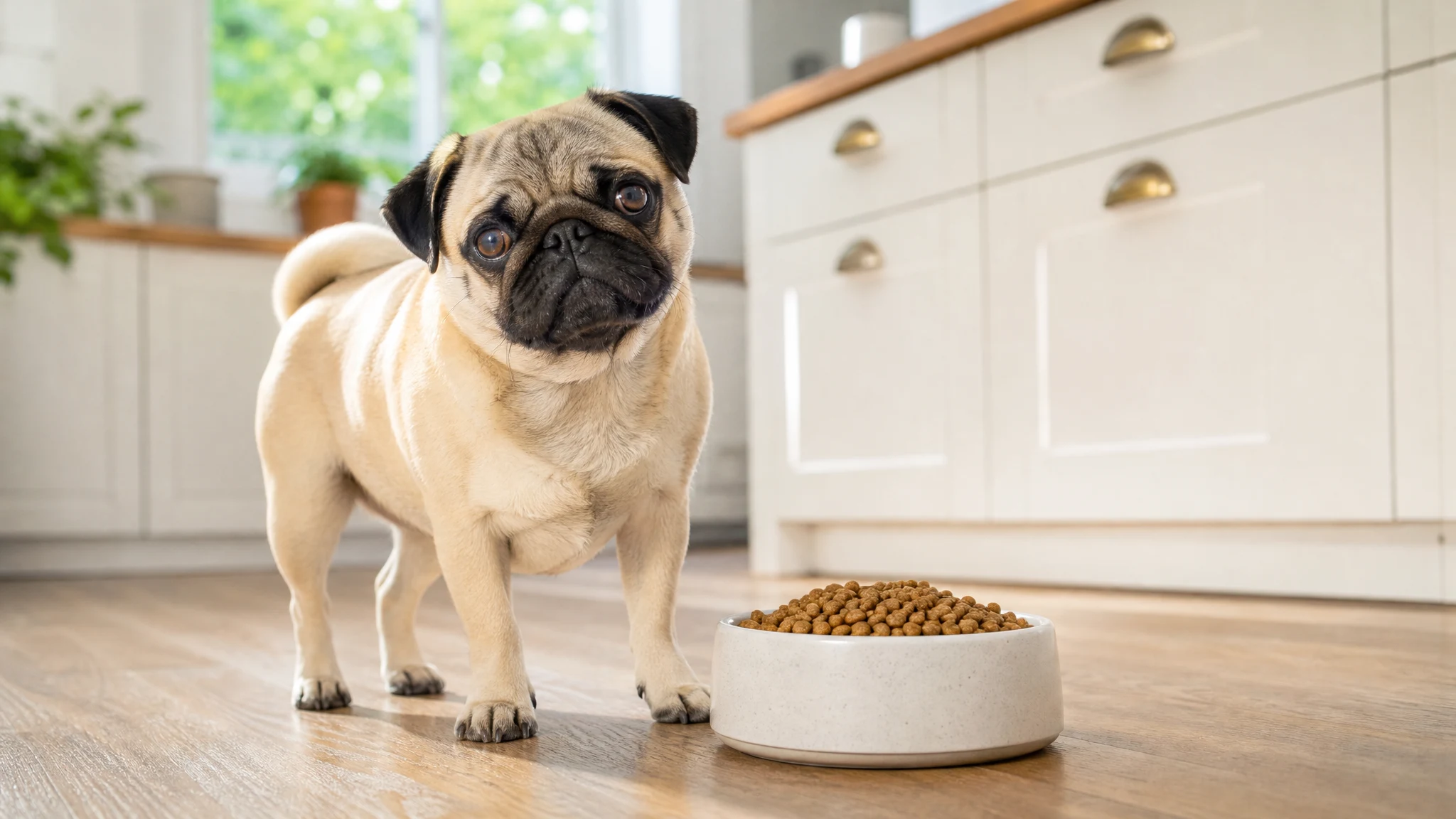
General nutrition information compiled from product labels and published sources, not veterinary advice. Your veterinarian is the right person to choose a diet for your dog, especially one with a health condition.
Picking the best food for pugs is mostly a matter of reading labels well and watching your own dog's waistline. Marketing language on the front of a bag tells you little. The small print on the back tells you much more.
This guide walks you through the process in order. We compared label data from the brands' own pages. We did not run feeding trials or taste tests, and nothing here says one food is right for every Pug.
What You Need Before You Start
- Your Pug's age, and a recent weight from a home scale or your veterinarian's office.
- The bag or the brand's product page for each food you are considering.
- A measuring cup, or a kitchen scale if you prefer grams.
- A notepad or phone note to record calories per cup, protein, fat and first ingredients.
- A list of questions for your veterinarian, who decides what suits your individual dog.
Step 1: Know the Dog You Are Feeding
Orvis, in its Pug breed profile, gives an average adult weight of 14 to 18 pounds and a life expectancy of 13 to 15 years. Those are typical ranges, not promises for your dog. A Pug is a small dog, so large-breed puppy formulas are not relevant here.
The same Orvis page lists obesity among the common Pug health issues. That is the main reason calories matter more than almost anything else on the label.
Write down your Pug's life stage: puppy, adult or senior. Royal Canin, for example, describes its Pug puppy formula for purebred Pugs from 8 weeks to 10 months, and its Pug adult formula for 10 months and older.
Step 2: Find the AAFCO Statement
The AAFCO nutritional adequacy statement is the line that says whether a food is complete and balanced, and for which life stage. Look for wording such as "formulated to meet the nutritional levels established by the AAFCO Dog Food Nutrient Profiles for maintenance" or "for growth."
Two details to notice:
- Formulated versus feeding tests. Hill's Science Diet pages say animal feeding tests using AAFCO procedures substantiate their recipes. Royal Canin, VICTOR and Freshpet use the "formulated to meet" wording on their pages.
- All life stages. VICTOR Hi-Pro Plus and the Freshpet small dog recipe are stated for all life stages, with an exclusion for growth of large-size dogs. That exclusion does not affect a Pug, since a Pug does not reach 70 pounds.
If a food has no statement for your dog's life stage, move on.
Step 3: Match Life Stage to Your Pug
A growing puppy and a 10-year-old Pug need different foods. Choose a puppy or all-life-stages statement for a young dog. Choose maintenance, or all life stages, for an adult.
Senior formulas, such as Hill's Science Diet Adult 11+ Small & Mini, are labeled for maintenance of adult dogs. Ask your veterinarian when your Pug should switch, because the source pages we checked do not state a single age for every dog.
Step 4: Compare Calories Per Cup
Calories per cup vary a lot between foods. A cup of one food can hold noticeably more energy than a cup of another, so swapping foods cup for cup can quietly add weight.
The table below shows label data from each brand's own page. Hill's lists protein and fat as dry matter averages rather than guaranteed minimums, so those figures are not directly comparable to the others.
| Food | Life stage | Protein | Fat | Calories | First ingredients |
|---|---|---|---|---|---|
| Royal Canin Pug Puppy (dry) | Growth | 27% min | 16% min | 369 kcal ME per cup | Chicken by-product meal, brewers rice, corn, chicken fat, wheat gluten |
| Royal Canin Pug Adult (dry) | Maintenance | 23% min | 14% min | 315 kcal ME per cup | Brewers rice, brown rice, oat groats, chicken by-product meal, corn |
| Hill's Science Diet Adult Perfect Weight Small & Mini (dry) | Maintenance | 28.8% (dry matter average) | 11.2% (dry matter average) | 298 kcal per cup | Chicken, cracked pearled barley, brown rice, pea fiber, corn protein meal |
| Hill's Science Diet Puppy Small & Mini (dry) | Growth | 28.9% (dry matter average) | 19.7% (dry matter average) | 418 kcal per cup | Chicken, whole grain oats, brown rice, chicken meal, chicken fat |
| VICTOR Hi-Pro Plus Small Breed Adult (dry) | All life stages | 30% min | 14% min | 360 kcal per cup | Beef, chicken meal, beef meal, brown rice, whole grain millet |
| Freshpet Small Dog Bite Size Chicken (fresh) | All life stages | 16% min | 12% min | 267 kcal per cup | Chicken, chicken liver, carrots, cranberries, eggs |
Our full side-by-side look, including more products, is in the best dog food for Pugs compared label by label.
Step 5: Read the First Five Ingredients
Ingredients are listed by weight, so the first five give a rough picture of the recipe. Look at what they are, not how appealing they sound.
Some plain observations from the labels above:
- Royal Canin's Pug formulas list rice, corn or oat groats alongside chicken by-product meal.
- Hill's and VICTOR lead with named meats, then grains such as barley, brown rice or sorghum.
- Freshpet's small dog recipe is grain free. Grain free is not the same as better, and no source here says a Pug needs it.
If you have read about the FDA's investigation into diets and canine dilated cardiomyopathy (DCM), note what the agency itself says. Its page was last updated December 23, 2022, and the FDA said it would not post further public updates until there is meaningful new scientific information. Raise any concern about your dog's diet with your veterinarian rather than guessing from ingredient lists.
Step 6: Check the Kibble Size and Form
Pugs have short, flat faces, and some owners find that kibble shape matters. Royal Canin says its Pug puppy kibble is shaped for the Pug's short, square muzzle, and its adult kibble is cloverleaf shaped. Neither page gives dimensions.
Hill's Adult 11+ Small & Mini is described as nibble size. For most other foods in our comparison, kibble size is not stated. If it matters to you, check with the brand directly.
Fresh and wet foods are options too. Freshpet's page gives 267 kcal per cup. JustFoodForDogs lists its Pantry Fresh Chicken & Rice by the 12.5 oz pack rather than by the cup, so you cannot compare it cup for cup.
Step 7: Start With the Label Feeding Guide
Every feeding chart is a starting point. Royal Canin's Pug adult page, for instance, lists 1 1/8 cups (92 g) a day for a 13 pound low-activity dog. VICTOR's small breed adult chart lists 1 cup daily for a 10 pound dog. Those are examples from the labels, not instructions for your Pug.
Measure each meal. Then adjust slowly based on your dog's body condition, and ask your veterinarian for a target weight. Hill's pages say to adjust amounts as necessary to maintain optimal weight, and to ask your veterinarian if unsure.
Step 8: Switch Foods Gradually and Watch
When you change foods, mix the new food into the old over about a week, increasing the new portion each day. Many owners do this to be gentle on the stomach, but ask your veterinarian for a plan that suits your dog.
Track weight every two to four weeks. Note stool quality, appetite and energy. Write down anything that changes.
Tips and Common Mistakes
- Feeding by the bag, not the dog. A chart is a guide. Your Pug's weight and body shape are the real feedback.
- Forgetting treats. Treats add calories. Count them in the daily total.
- Comparing protein across different bases. A dry matter figure and an as-fed minimum are not the same measure.
- Trusting front-of-bag claims. Words like "premium" or "natural" are not nutrient data.
- Adding supplements on your own. A complete and balanced food already covers the basics. Ask your veterinarian before adding anything.
- Assuming food will fix a health condition. Orvis lists hip dysplasia, Legg-Perthes disease, patellar luxation and Pug Dog Encephalitis as Pug concerns. A diet choice is not a treatment for any of them.
- Buying prescription diets without a prescription. Those are something only a veterinarian prescribes.
What Results to Expect
A well-chosen, correctly portioned food may help your Pug hold a steady weight and eat a diet that matches their life stage. Results vary by dog, and no label can promise a particular outcome.
Weight is worth watching closely. A Texas A&M College of Veterinary Medicine press release from June 16, 2026 describes a clinical trial in short-muzzled dogs, including a Pug. Dogs that reached an ideal weight showed improvements, and the trial was still ongoing at the time of the release. That is early information, not proof that weight loss resolves breathing problems.
If your Pug seems to be gaining weight, snoring harder or tiring easily, talk with your veterinarian before changing anything yourself.
Quick Checklist
- Record your Pug's age and current weight.
- Find an AAFCO statement that fits the life stage.
- Compare calories per cup, not just protein and fat.
- Read the first five ingredients.
- Check kibble size or form with the brand if it matters.
- Start from the label feeding guide and measure meals.
- Transition gradually and track weight.
- Review the choice with your veterinarian.
Sources
- Orvis Pug breed page
- Texas A&M College of Veterinary Medicine press release, June 16, 2026
- FDA CVM: Investigation into Potential Link between Certain Diets and Canine Dilated Cardiomyopathy
- Royal Canin Pug Puppy product page
- Royal Canin Pug Adult product page
- Hill's Science Diet Adult Perfect Weight Small & Mini product page
- Hill's Science Diet Puppy Small & Mini product page
- Hill's Science Diet Adult 11+ Small & Mini product page
- VICTOR Hi-Pro Plus Small Breed Adult product page
- Freshpet Small Dog Bite Size Chicken Recipe product page
- JustFoodForDogs Pantry Fresh Chicken & Rice Recipe product page