Royal Canin Pug Puppy Food: How It Compares on the Label
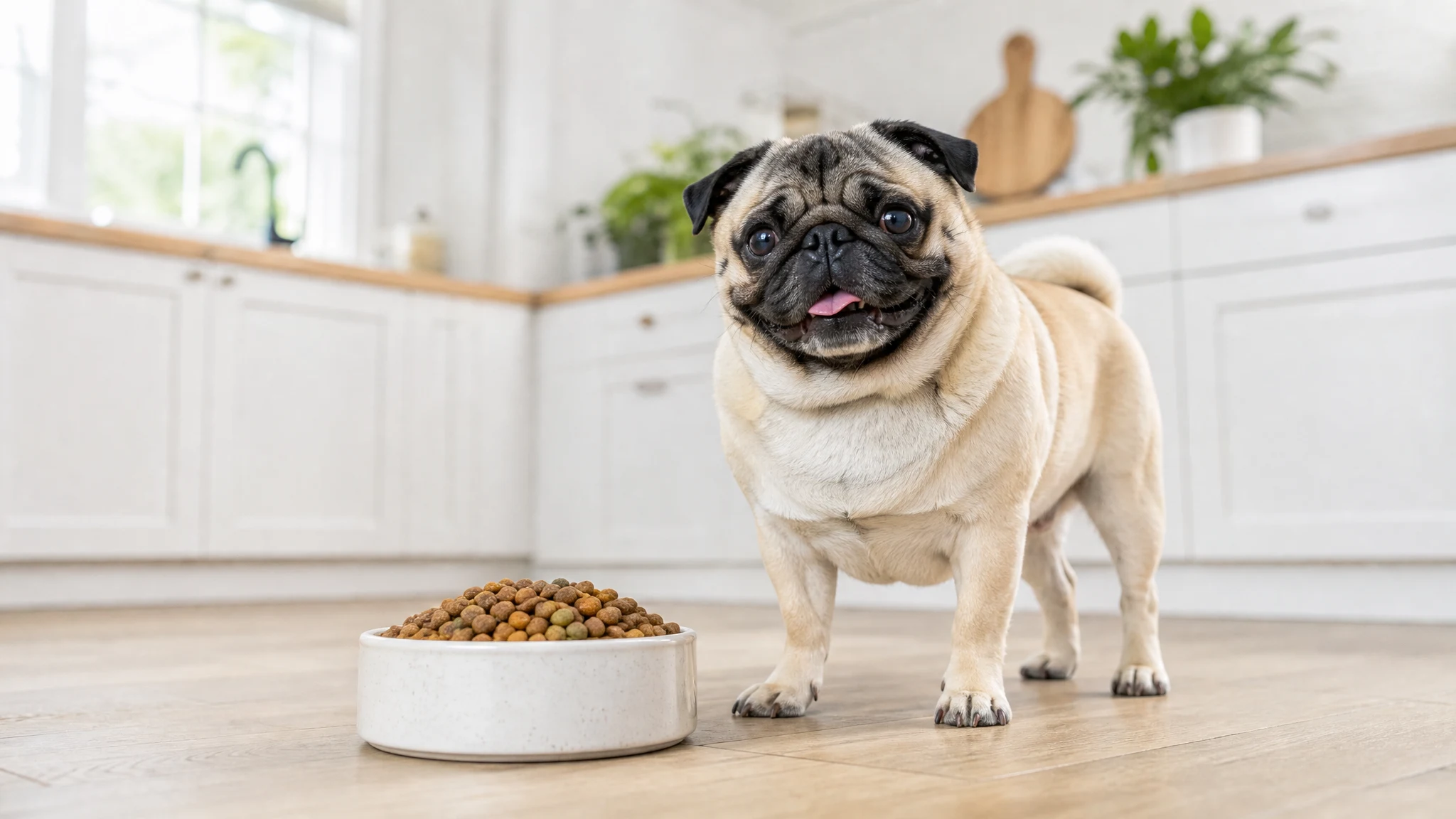
General nutrition information compiled from product labels and published sources, not veterinary advice. Your veterinarian is the right person to choose a diet for your dog, especially one with a health condition.
Pug owners often hear that a breed-specific formula is the safe choice. A label can tell you what a food claims and contains. It cannot tell you how your puppy will do on it.
This guide shows how to read the label of royal canin pug puppy food and line it up against other small-breed puppy foods. We compared label data from the brands' own pages. We did not run feeding trials or taste tests, and nothing here says one food is better for every Pug.
What You Need Before You Start
- The bag or the brand's product page for each food you want to compare.
- A notepad or spreadsheet with one column per food.
- Your puppy's age and an estimate of adult weight. The Orvis Pug breed page lists an average adult weight of 14 to 18 pounds, so treat that as a typical range, not a promise.
- Your veterinarian's current weight and body condition notes for your puppy.
Step 1: Find the AAFCO Statement
Start with the nutritional adequacy statement. It is usually in small print near the guaranteed analysis. It tells you which life stage the food is built for.
The Royal Canin Pug Puppy page says the food is formulated to meet the AAFCO Dog Food Nutrient Profiles for growth. The brand lists it for purebred Pugs from 8 weeks to 10 months.
Note the wording. "Formulated to meet" means the recipe was designed to match the AAFCO profile. A different phrase, "animal feeding tests using AAFCO procedures substantiate," means the brand reports feeding tests. The Hill's Science Diet Puppy Small & Mini page uses that second wording. Both are legitimate routes to a complete and balanced claim. Write down which one each food uses.
Step 2: Match the Life Stage
A puppy should eat a food whose statement covers growth or all life stages. The VICTOR Hi-Pro Plus Small & Medium Breed Puppy page lists an all life stages statement. Royal Canin and Hill's list growth.
Do not feed an adult-only food to a puppy because the bag looks similar. Royal Canin's adult Pug formula is listed for dogs 10 months and older.
Step 3: Record Protein, Fat and Fiber
Copy the guaranteed analysis exactly as printed. Minimums for protein and fat and maximum for fiber are the standard format.
Watch the basis. Some pages give as-fed minimums. The Hill's page shows only an average nutrient table on a dry matter basis. Those numbers are not directly comparable to as-fed minimums, so do not rank them against each other.
Step 4: Compare Calories Per Cup
Calories decide how much you pour. The Royal Canin page lists 369 kcal ME per cup (as fed, calculated) for the Pug Puppy formula. The Hill's page lists 418 kcal per cup. The VICTOR page lists 383 kcal per cup.
A higher number means fewer cups for the same energy. It does not mean a better food.
Step 5: Read the First Five Ingredients
Ingredients are listed by weight before cooking. The first five give a rough picture of what the recipe is built on. They do not show quality, digestibility or how a food performs.
Royal Canin lists chicken by-product meal, brewers rice, corn, chicken fat and wheat gluten. Hill's lists chicken, whole grain oats, brown rice, chicken meal and chicken fat. VICTOR lists beef, chicken, beef meal, chicken meal and whole grain sorghum.
Be careful with "by-product meal" and "meal." These are defined ingredient terms, not automatic warnings. They are also not automatic endorsements. If your puppy has a known food sensitivity, your veterinarian is the one to say which ingredients to avoid.
Side-by-Side Label Summary
| Food | AAFCO wording | Protein / fat | Calories per cup |
|---|---|---|---|
| Royal Canin Pug Puppy (dry) | Formulated to meet growth profile | 27% min / 16% min | 369 kcal ME |
| Hill's Science Diet Puppy Small & Mini (dry) | Feeding tests substantiate growth | Page gives dry matter averages only: 28.9% / 19.7% | 418 kcal |
| VICTOR Hi-Pro Plus Small & Medium Breed Puppy (dry) | Formulated to meet all life stages | 30% min / 18% min | 383 kcal |
The VICTOR page body text mentions a 26% protein ratio, while its table shows a 30% minimum. We used the table figure. If that matters to you, confirm with the brand.
Step 6: Check the Feeding Guide as a Starting Point
Each label guide is a starting point, not a prescription. The Royal Canin Pug Puppy page has a daily table by puppy age and target adult weight. A 2-month-old with a 13 pound target adult weight is listed at 1 1/8 cups (105 g) per day.
Its table covers target adult weights of 13, 18 or 22 pounds. Ask your veterinarian which row suits your puppy, since adult size is only an estimate at 8 weeks.
Step 7: Ask About Kibble Size and Shape
Royal Canin says its Pug Puppy kibble is custom shaped for the Pug's short, square muzzle. The page gives no dimensions. The Hill's and VICTOR puppy pages we reviewed do not state kibble size either.
Shape claims are the brand's description. Watch your own puppy at mealtime and ask the brand or your veterinarian if chewing looks hard.
Step 8: Keep Weight in the Picture
The Orvis Pug breed page lists obesity among common Pug health issues. A Texas A&M College of Veterinary Medicine press release from June 16, 2026 describes an ongoing clinical trial in short-muzzled dogs, including a Pug. It reports that dogs reaching ideal weight showed improvements. The trial is still running, so it does not show that any food changes breathing.
The practical point is simple. Measure portions, and have your veterinarian check body condition at each visit.
Tips and Common Mistakes
- Comparing different bases. Do not set an as-fed minimum against a dry matter average.
- Judging by the front of the bag. Breed names and photos are marketing. The statement, analysis and ingredient panel are the facts.
- Treating a label as a health claim. A complete and balanced statement is about nutrient levels. It does not say a food prevents or treats any condition, and we make no such claim.
- Switching all at once. Ask your veterinarian how to transition foods gradually.
- Adding supplements. Do not add extras unless your veterinarian recommends them.
- Following a grain-free trend. The FDA's investigation into diets and canine dilated cardiomyopathy had its latest update on December 23, 2022. The FDA said it would not release further public updates until there is meaningful new scientific information. Talk to your veterinarian about your puppy's diet instead of reacting to headlines.
- Quoting price or availability. We have not listed prices. Check the brand for current details.
What to Expect
Done carefully, this process may leave you with a clear, written comparison and a short list of questions for your veterinarian. It may also help you notice when a bag's marketing is louder than its label.
It will not tell you how your puppy digests a food, whether the puppy likes it, or whether it suits your puppy's health. Those answers come from your puppy's growth, stool, coat, energy and your veterinarian's checks over time.
For more foods compared the same way, see the best dog food for Pugs compared label by label.
Sources
- Royal Canin US: Pug Puppy Dry Dog Food
- Hill's Pet US: Science Diet Puppy Small & Mini Chicken & Brown Rice Recipe
- VICTOR Super Premium Pet Food: Hi-Pro Plus Small & Medium Breed Puppy
- Orvis Pug breed page
- Texas A&M College of Veterinary Medicine press release, June 16, 2026
- FDA CVM: Investigation into Potential Link between Certain Diets and Canine Dilated Cardiomyopathy