Wet vs Dry vs Fresh Food for Pugs
General nutrition information compiled from product labels and published sources, not veterinary advice. Your veterinarian is the right person to choose a diet for your dog, especially one with a health condition.
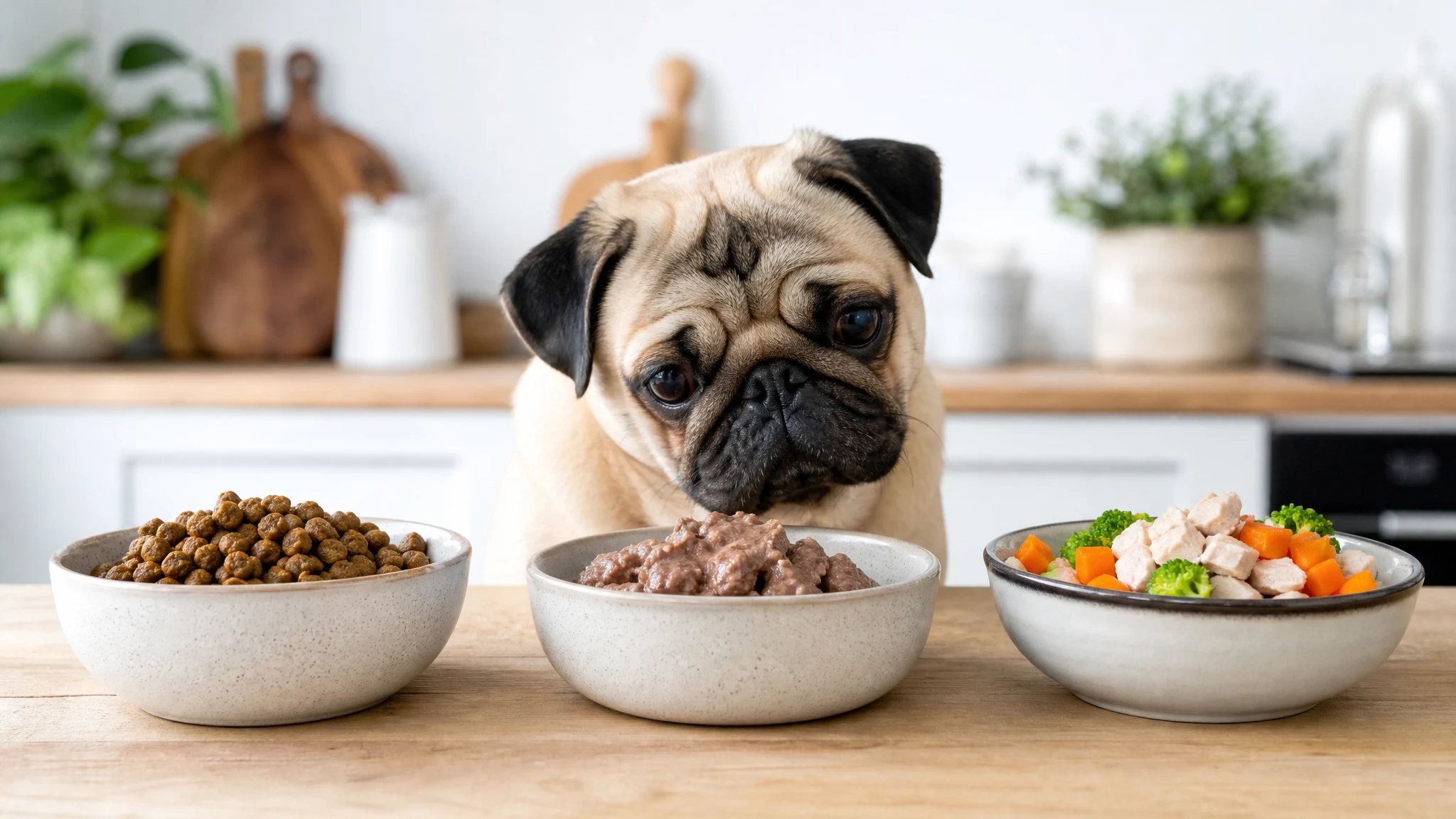
Pet food aisles sell three big ideas: crunchy kibble, canned or pouched wet food, and refrigerated fresh food. Each comes with confident marketing. For a Pug, the more useful question is plainer: which form fits your dog's weight, mouth, budget and daily routine?
This page compares the three forms using label data from real products. We compared labels only. We did not run feeding trials or taste tests, so nothing here says which food a Pug enjoys or thrives on.
Why the form matters for a Pug
Pugs are small. The Orvis Pug breed page gives an average adult weight of 14 to 18 pounds and lists obesity among the breed's common health issues. When a dog is that small, a few extra bites a day add up fast.
The Texas A&M College of Veterinary Medicine described a clinical trial in short-muzzled dogs, including a Pug, in a June 16, 2026 press release. Dogs that reached an ideal weight showed improvements in breathing. The trial was still ongoing at that point, so it is early evidence. It does suggest that portion control is worth taking seriously, and the form of food affects how easy that is.
No food form treats or prevents a health condition. Your veterinarian decides what suits an individual dog, especially one with weight or airway concerns.
The products we used for comparison
To keep this grounded, we used label data from products whose pages we could read. They are examples of each form, not a ranking.
- Dry: Royal Canin Pug Adult, Hill's Science Diet Adult Perfect Weight Small & Mini, and VICTOR Hi-Pro Plus Small Breed Adult.
- Wet: Royal Canin Mature 8+ Loaf in Sauce (a canned food for small breeds up to 22 lb) and JustFoodForDogs Pantry Fresh Chicken & Rice, a shelf-stable moist meal in a 12.5 oz pack.
- Fresh: Freshpet Small Dog Bite Size Chicken Recipe.
For a label-by-label look at more products, see our comparison of dog foods for Pugs.
Side-by-side comparison
| Attribute | Dry | Wet | Fresh |
|---|---|---|---|
| Example labels | Royal Canin Pug Adult; Hill's Perfect Weight Small & Mini; VICTOR Hi-Pro Plus Small Breed Adult | Royal Canin Mature 8+ loaf; JustFoodForDogs Pantry Fresh | Freshpet Small Dog Bite Size Chicken |
| Calories as listed | 298 to 360 kcal per cup | 145 kcal per can (Royal Canin); 387.5 kcal per 12.5 oz pack (JustFoodForDogs) | 267 kcal per cup |
| First ingredient | Brewers rice (Royal Canin); chicken (Hill's); beef (VICTOR) | Water (Royal Canin); chicken breast (JustFoodForDogs) | Chicken |
| Guaranteed protein (minimum) | 23% (Royal Canin); 30% (VICTOR); Hill's lists only a dry matter average | 7% (Royal Canin); 6.5% (JustFoodForDogs) | 16% |
| Texture and size | Royal Canin Pug Adult is cloverleaf shaped; VICTOR says bite-sized; Hill's gives no size | Loaf in sauce; moist meal | Bite size pieces, no dimensions stated |
| Handling | Check each brand's storage directions | Check each brand's storage directions | Check the brand's storage directions |
| Cost per day, in general terms | Usually the lowest of the three | Usually higher than dry | Usually higher than dry |
Two cautions on reading this table. First, the protein figures are not directly comparable. A wet food is mostly water, so its percentages look small even if the food is perfectly nutritious. Hill's publishes only a dry matter average, which is another basis again. Second, the serving units differ. A cup, a can and a pack are not the same amount of food, so a bigger number does not mean a richer food.
Moisture
Wet and fresh foods contain more water than kibble. The Royal Canin Mature 8+ label lists water sufficient for processing as its first ingredient, which is typical of canned loaf. The pages we read did not give a moisture figure for each product, so check the guaranteed analysis on the label or ask the brand.
More water does not automatically mean better hydration for your dog, and it does not make a food healthier. It mostly changes the texture and how many calories fit in a spoonful. Any dog should have fresh water available regardless of the food form.
Calories per serving
This is where the forms differ most in practice. The three dry foods list 298 kcal per cup for Hill's Perfect Weight, 315 kcal for Royal Canin Pug Adult and 360 kcal for VICTOR Hi-Pro Plus Small Breed Adult. Freshpet lists 267 kcal per cup. The Royal Canin canned food lists 145 kcal per can, and the JustFoodForDogs pack lists 387.5 kcal for the whole 12.5 oz pack.
A Pug's daily needs are small, so a few kibbles over the guide matter. Dry food packs a lot of calories into a small scoop, and a heavy hand with the cup is an easy mistake. Wet food looks like a bigger meal for the same calories, which some owners find helpful and some find expensive.
Every brand's feeding guide is a starting point. The Royal Canin Pug Adult page, for instance, lists 1 1/8 cups (92 g) per day for a 13 lb, low-activity dog. Hill's pages say to adjust amounts to maintain optimal weight and to ask your veterinarian if unsure. That is sound advice for any Pug.
Cost per day
We are not quoting prices, because they change and vary by store. In general terms, dry food tends to be the most economical way to buy calories. Wet and fresh foods tend to cost more per day, and the gap grows with portion size. For a 14 to 18 lb dog the gap is smaller than it would be for a large breed, which is one reason fresh food is more realistic for a Pug than for a Great Dane.
Compare cost per day, not cost per bag or can. Use the brand's feeding guide for your dog's weight, work out the daily amount, and check the current price on the brand's own page.
Dental myths
A common belief is that kibble cleans teeth and wet food ruins them. The product pages we compared do not give dental data, so we cannot say that any of them does either. Texture alone is not a substitute for dental care. If you are worried about your Pug's teeth, ask your veterinarian about brushing and dental checkups.
Pugs have short, crowded mouths, but the sources we used do not say which food form is better for them. Do not assume a form is protective or harmful because of marketing around crunch.
Kibble size and the Pug muzzle
Royal Canin describes its Pug Puppy kibble as custom shaped for the Pug's short, square muzzle, and its Pug Adult kibble as cloverleaf shaped. No dimensions are given for either. Hill's Adult 11+ Small & Mini is described as nibble size, and VICTOR's small breed adult is described as bite-sized, again without measurements.
Those are brand descriptions. The pages do not show that a shape helps a Pug eat better. If your dog struggles to pick up kibble, a wet or fresh food, or a different shape, may be easier. Ask your veterinarian if you notice trouble chewing or swallowing.
Pros and cons of each form
Dry food
- Pros: usually the lowest cost per day, easy to measure, simple to store, and the widest range of Pug-specific and small-breed formulas, including puppy, adult and weight management options.
- Cons: calorie dense, so over-scooping is easy. Some dogs find it less appealing. Ingredient lists vary widely, so read them.
Wet food for Pugs
- Pros: soft texture, appealing to picky eaters, and a larger-looking portion for the calories. Useful if chewing hard kibble is a problem.
- Cons: usually costs more per day, and opened cans need careful handling. The cans we reviewed are sized by dog weight, so check the portion table. The Royal Canin Mature 8+ product is aimed at small breeds over 8 years, so it will not suit every Pug.
Fresh dog food for Pugs
- Pros: recognizable ingredients such as chicken, chicken liver, carrots and eggs at the top of the Freshpet label, and a soft, bite size format. The recipe lists an all life stages AAFCO statement that excludes growth of large size dogs, which is not a concern for a 14 to 18 lb breed.
- Cons: usually the highest cost per day, needs the storage the brand specifies, and the feeding amount depends on your dog's weight. The label also gives no kibble size or dimensions.
The JustFoodForDogs Pantry Fresh product is a shelf-stable moist meal, so it sits between wet and fresh. It is not breed or size specific, and its page offers a feeding calculator rather than a fixed table.
Mixing forms
Many owners combine dry with a spoonful of wet or fresh food. The label data suggests this can work, since every product we read carries an AAFCO statement of nutritional adequacy for its life stage. The catch is calories. If you add wet food, reduce the dry portion so total intake does not creep up.
A few tips for mixing:
- Stay with foods suited to your Pug's life stage. A puppy food, an adult food and a senior food are formulated differently.
- Count the calories of both foods against the daily amount your veterinarian suggests.
- Change one thing at a time and introduce new foods gradually.
Some labels carry a feeding test statement and some a formulation statement. Hill's pages say animal feeding tests using AAFCO procedures substantiate their foods. Royal Canin and VICTOR say their foods are formulated to meet AAFCO nutrient profiles. Both are legitimate routes, and they are different claims.
Best for: recommendations by use case
- A Pug prone to gaining weight: a measured dry food with a published calorie figure is easy to portion. Hill's Perfect Weight Small & Mini lists 298 kcal per cup and a higher fiber average. Your veterinarian should guide the target weight.
- A Pug puppy: choose a puppy or all life stages formula. Royal Canin Pug Puppy and Hill's Puppy Small & Mini are examples of dry puppy foods on the labels we read.
- A picky eater: wet or fresh food, or a small amount mixed into dry.
- A senior Pug: Royal Canin Mature 8+ in wet form, or Hill's Adult 11+ Small & Mini in dry. Pugs typically live 13 to 15 years, according to Orvis.
- A tight budget: dry food, measured carefully.
- An owner who wants fresh ingredients: Freshpet Small Dog Bite Size Chicken Recipe, or the JustFoodForDogs Pantry Fresh pack if you prefer a shelf-stable option.
A note on grain and heart health
The FDA's investigation into a potential link between certain diets and canine dilated cardiomyopathy (DCM) has not had a public update since December 23, 2022. The agency said it would not release further updates until there is meaningful new scientific information. Freshpet's recipe is listed as grain free, while the other products we reviewed are not. The FDA page does not tell owners to avoid a food form, and we draw no conclusion from it. If you have concerns about your dog's diet and heart health, speak with your veterinarian.
Verdict
There is no single best form for every Pug. If we had to name a practical default, it is a measured, complete and balanced dry food suited to your dog's life stage, with wet or fresh food added when the dog needs it. The reasoning is simple. Dry food is usually the cheapest per day and the easiest to portion, and portion control is the issue the breed's weight concerns point to.
Wet food for Pugs earns its place with seniors, picky eaters and dogs that struggle with kibble. Fresh dog food for Pugs suits owners who prioritize ingredients and accept a higher cost and stricter storage. In any of these cases, the first things to check are the AAFCO statement, the calories per serving and the life stage.
The wet vs dry dog food question is really a question about your own dog. Weigh your Pug regularly, adjust portions to the brand's guide as a starting point, and talk to your veterinarian before changing diets for a dog with health concerns. For brands and details, check each company's own page, because formulas and labels can change.
Sources
- Orvis Pug breed page
- Texas A&M College of Veterinary Medicine press release, June 16, 2026
- FDA: Investigation into Potential Link between Certain Diets and Canine Dilated Cardiomyopathy
- Royal Canin Pug Adult
- Royal Canin Pug Puppy
- Royal Canin Mature 8+ Loaf in Sauce
- Hill's Science Diet Adult Perfect Weight Small & Mini
- Hill's Science Diet Puppy Small & Mini
- Hill's Science Diet Adult 11+ Small & Mini
- VICTOR Hi-Pro Plus Small Breed Adult
- Freshpet Small Dog Bite Size Chicken Recipe
- JustFoodForDogs Pantry Fresh Chicken & Rice Recipe