Best Training Treats for Pugs (and How Many to Give)
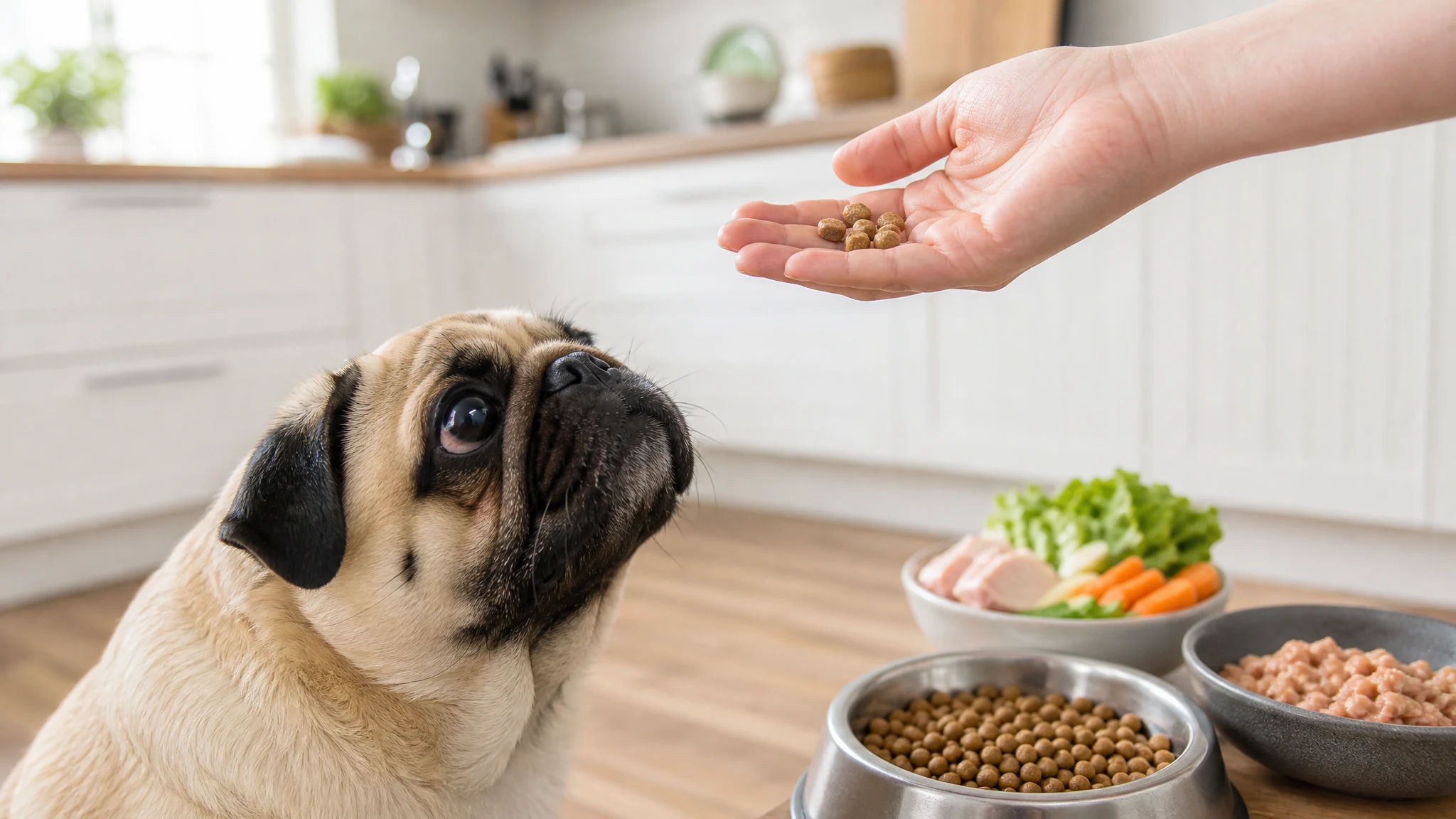
General nutrition information compiled from product labels and published sources, not veterinary advice. Your veterinarian is the right person to choose a diet for your dog, especially one with a health condition.
Pugs are food-motivated, which makes training easier and weight control harder. Orvis lists obesity among the common Pug health issues. The best treats for Pugs are therefore small, soft, low in calories and easy to count.
This guide shows how to pick training treats for Pugs, size them, and work out how many fit into a day. It compares categories, not brands, because treat label data is not something we have verified for specific products.
Why treat math matters more for a Pug
Orvis gives the average adult Pug weight as 14 to 18 pounds. A dog that small has little room for extra calories. A handful of treats can be a large share of the day's energy.
A Texas A&M College of Veterinary Medicine press release from June 16, 2026 describes a clinical trial in short-muzzled dogs, including a Pug. Dogs that reached an ideal weight showed improvements in breathing. The trial was still ongoing at the time of the release, so treat it as an early signal and not a promise. It does show why a Pug owner may want to keep treat calories in check.
Your veterinarian decides what ideal weight and daily calories mean for your individual dog.
Materials you need
- Your dog's regular food, with its calorie figure from the label or the brand's website.
- A kitchen scale or a measuring cup for the daily food portion.
- A calculator or phone.
- Two or three types of treats from the categories below.
- A small treat pouch or a lidded container for the day's treats.
- A knife and cutting board for making treats smaller.
Treat categories to consider
Soft training treats
Soft treats are easy to break into tiny pieces and are quick to swallow. That keeps training sessions moving. Look for a calorie statement on the package, usually given per treat or per piece. If the package gives no calorie figure, check with the brand before you rely on it.
Soft treats can run higher in calories per bite than people expect, so the label figure matters more than the size.
Freeze-dried single protein treats
These are made from one animal protein, such as one kind of poultry or fish. A short ingredient list makes it easier to see what your dog is eating. It also helps if a veterinarian asks you to track what your dog tolerates.
They are usually light and crumbly. That helps with sizing, since you can snap a piece into several tiny rewards. Again, read the calorie statement on the package.
Vegetables
Some dogs will work for small pieces of plain vegetable. Plain means no salt, oil, butter or seasoning. Before you add any new vegetable, ask your veterinarian whether it is suitable for your dog. Some foods that are safe for people are not safe for dogs.
Vegetable pieces can be a useful low-calorie reward for dogs that accept them. Many Pugs will still prefer meat flavors, so you may use them for easy cues and save the meat treats for harder ones.
Step-by-step: choosing and portioning Pug treats
Step 1: Find your dog's daily calorie target
Ask your veterinarian how many calories your Pug should eat per day to stay at or reach a healthy weight. Pugs vary with age, activity, and whether they are neutered, so a general chart is only a rough guide.
The feeding guide on a dog food label is a starting point, not a prescription. For example, the Royal Canin Pug Adult dry food page lists a 13 pound, low-activity dog at 1 1/8 cups (92 g) per day. It lists the food at 315 kcal ME per cup, as fed and calculated. The brand's own page is at Royal Canin's Pug Adult page. Your own dog may need more or less than any label suggests.
Step 2: Apply the 10 percent rule
The World Small Animal Veterinary Association (WSAVA) calorie guidance for treats is that they should make up no more than about 10 percent of a dog's daily calories. The rest should come from a complete and balanced diet.
Here is the arithmetic using the label example above. 1 1/8 cups at 315 kcal per cup is about 354 kcal. Ten percent of that is roughly 35 kcal for all treats that day. That number is only an illustration. Use the target your veterinarian gives you.
Treat calories count toward the day's total. If your Pug will eat treats, trim the meal portion a little so the day does not run over. Ask your veterinarian how much to trim.
Step 3: Read the treat's calorie figure
Find the calories per treat on the package. If the package lists only calories per kilogram or per bag, you will need the treat count or weight to work out each piece. When a brand does not publish this, contact the brand and ask before you buy.
Divide your daily treat allowance by calories per treat. That gives the number of whole treats you could use. Because training uses many repetitions, you will usually cut each treat into smaller pieces.
Step 4: Cut treats to the right size
For a small dog with a short, broad muzzle, smaller is better. A common rule of thumb is about the size of a pea, or smaller for soft treats. This is a practical tip, not a measured standard, and no source we cite sets a size for Pugs.
Tiny pieces keep calories low and the pace fast. They also reduce the chance your dog will gulp or choke on a big chunk. Pugs can be noisy, fast eaters, so smaller pieces and a calm pace are sensible.
Cut pieces so they can be swallowed with little chewing. Watch your dog on the first few sessions. If your dog coughs, gags or struggles, stop and ask your veterinarian.
Step 5: Measure out the day's treats in the morning
Put the whole day's allowance in your pouch or container. When it is empty, training treats are done for the day. This is the simplest way to keep to the 10 percent figure, especially when several family members hand out treats.
Count anything else that is food-like as well. Dental chews, bits of cheese, and scraps from the table all add calories.
Step 6: Reward quickly, with humane methods
Reward the behavior within a second or two, such as a sit or a look at you. The American Veterinary Society of Animal Behavior (AVSAB) supports reward-based training and advises against punishment-based methods. Keep sessions short and upbeat, a few minutes at a time.
Pair each treat with calm praise. Over time you can reward some repetitions with praise or a pat only, which also lowers treat calories.
Step 7: Use a low-value and high-value ladder
Use the least exciting treat that still works. Easy cues at home may need only a vegetable piece or a crumb of a freeze-dried treat. Save the best treat for new places or harder cues. This lets you spend fewer calories per session.
Step 8: Review the plan every few weeks
Check your dog's body condition and weight with your veterinarian. If weight is rising, reduce treats first, then ask about meal portions. If your Pug is on a weight-management plan, follow the veterinarian's instructions over any rule of thumb here.
Common mistakes to avoid
- Treating without counting. Many small rewards add up quickly for a 14 to 18 pound dog.
- Large pieces. A big treat is a lot of calories in one bite and is harder for a short-muzzled dog to manage.
- Forgetting to trim the meal. Treats are extra calories unless you adjust.
- Judging by the front of the package. Words like natural or premium do not tell you the calories. The calorie statement and ingredient list do.
- Using treats to fix a health problem. No treat prevents or treats hip dysplasia, allergies or breathing problems. Those are questions for your veterinarian.
- Giving human foods without checking. Some are unsafe for dogs. Ask your veterinarian first.
- Using harsh corrections. Shock, prong or choke collars, alpha rolls and scruffing are not part of reward-based training and are not recommended.
A note on treats and the main diet
Treats do not need to be complete and balanced, but the main food does. If you are still choosing a daily food, our label-by-label comparison of dog foods for Pugs covers what the labels say. We compared label data only. We did not run feeding trials or taste tests.
You can also use part of your dog's regular kibble as training rewards. This is often the lowest-calorie option, because those calories already sit within the daily food portion.
What results to expect
With consistent, small rewards, many dogs learn simple cues such as sit, come and look at me over a few weeks. Progress varies with age, history and distraction level, and no result is guaranteed.
Keeping treats to a modest share of daily calories may help support a steady weight. It is one part of the picture, alongside meals, exercise and veterinary care. If your Pug's weight, breathing or appetite changes, call your veterinarian.
Quick recap
- Get a calorie target from your veterinarian.
- Keep treats to about 10 percent of daily calories, following WSAVA guidance.
- Check the calories per treat on each package.
- Cut treats to pea size or smaller.
- Portion the day's treats in the morning.
- Reward quickly using humane, reward-based methods.
- Recheck weight and adjust.
Sources
- Orvis Pug breed page (typical weight and common health issues)
- Texas A&M College of Veterinary Medicine press release, June 16, 2026
- Royal Canin US, Pug Adult Dry Dog Food (feeding guide and calories used in the example)