How a Pug's Feeding Amount Changes From 8 Weeks to 8 Years
General nutrition information compiled from product labels and published sources, not veterinary advice. Your veterinarian is the right person to choose a diet for your dog, especially one with a health condition.
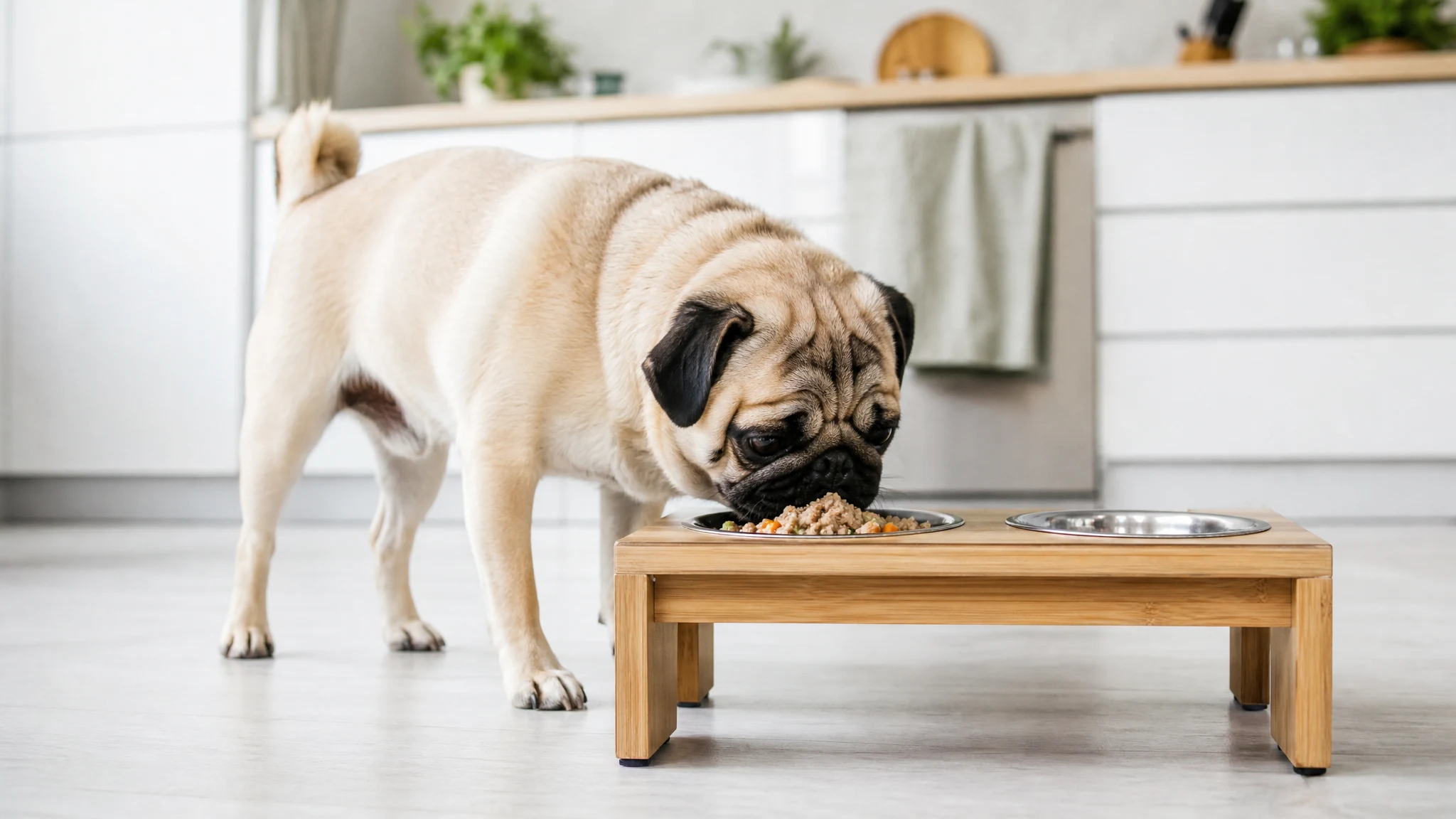
A Pug does not eat the same amount at 8 weeks, 1 year and 8 years. Growth, activity and body condition all shift what a bowl should hold. The goal here is a method, not a magic number.
Any pug feeding chart by age is only a starting point. The numbers on a food label are averages, and your Pug may need more or less. This guide shows how to read the label, set a first amount and adjust it over the years.
For a full reference table, see our Pug feeding chart by age and weight.
How we compared the foods
We compared label data from each brand's own product page: the AAFCO statement, ingredients, guaranteed analysis, calories and feeding guide. We did not run feeding trials or taste tests, and we are not ranking foods. We use them only to show how label amounts differ by life stage.
What you need
- A complete and balanced food whose AAFCO statement matches your Pug's life stage.
- A standard measuring cup, or better, a kitchen scale. Royal Canin lists grams as well as cups, and Victor says its chart uses an 8 oz. measuring cup.
- A bathroom scale or a vet's scale to track your dog's weight.
- A notebook or phone note for weights, portions and treats.
- Your veterinarian's number, since they decide for an individual dog.
Know the typical Pug first
The Orvis Pug breed page gives an average adult weight of 14 to 18 pounds and a life expectancy of 13 to 15 years. That makes 8 years a mature adult, not yet a very old one. The same page lists obesity among common Pug health issues, so portion control matters for this breed.
Texas A&M's College of Veterinary Medicine announced a clinical trial in short-muzzled dogs, including a Pug, on June 16, 2026. It reported that dogs reaching an ideal weight showed improvements in breathing. The trial was still ongoing at the time, so treat it as early. It is a reason to keep your Pug lean, not a promise of any result.
Step by step: setting and adjusting your Pug's portions
Step 1: Pick a food for the life stage
Read the AAFCO statement on the brand's page. A growth or all life stages statement suits a puppy. A maintenance statement suits an adult.
Royal Canin makes Pug-specific formulas. Its puppy page covers purebred Pugs from 8 weeks to 10 months. Its adult page covers Pugs 10 months and older. The AAFCO text for the puppy food says it is formulated for growth, including growth of large size dogs. A Pug is not a large-size dog, so that wording is not a reason to choose it.
Other labels also fit small dogs. VICTOR's Hi-Pro Plus puppy and small breed adult foods carry all life stages statements. Hill's Science Diet has small and mini puppy, perfect weight and 11+ recipes.
Step 2: Find the label's starting amount (8 weeks to about 10 months)
For a young puppy, use the age and expected adult weight on the feeding table. The Royal Canin Pug Puppy page lists daily amounts by age from 2 to 10 months and by target adult weight of 13, 18 or 22 lb. For a 2-month-old with a 13 lb target adult weight, it lists 1 1/8 cups (105 g) per day.
That food is listed at 369 kcal ME per cup. Hill's Science Diet Puppy Small & Mini lists 418 kcal per cup, and VICTOR's puppy food lists 383 kcal per cup. A cup of one food is not a cup of another, so never swap foods cup for cup.
Hill's does not give a puppy table on the page we reviewed. It tells owners to adjust amounts to maintain optimal weight and to ask a veterinarian if unsure. Ask your vet or check the brand if your chosen food gives no chart.
Step 3: Decide on meal timing with your vet
We found no source for an exact number of meals per day for Pugs. Brand pages give daily totals, which you can split into portions. Ask your veterinarian how many meals suit your puppy, and use the same schedule each day.
Step 4: Re-check as your Pug grows
Weigh your puppy regularly and compare it with the table's next age row. Puppy amounts on a label rise with age, so do not keep feeding the 8-week portion. Watch the body, not only the cup. You should be able to feel the ribs under a thin layer of fat, and your Pug should have a visible waist.
Step 5: Move to an adult food and amount (around 10 months and up)
Royal Canin treats purebred Pugs as adults from 10 months. We found no breed-wide source that sets an exact age for adulthood, so ask your vet when to switch. When you do, change foods gradually and ask your vet how slowly to go.
Adult labels use weight and activity. The Royal Canin Pug Adult page lists 1 1/8 cups (92 g) per day for a 13 lb, low-activity dog, at 315 kcal ME per cup. VICTOR's Small Breed Adult chart lists 1 cup daily for a 10 lb dog and 2 1/4 cups for a 30 lb dog, at 360 kcal per cup. Those two weights are not a typical Pug's, so a Pug at 14 to 18 lb falls between the rows. Use the brand's calculator or chart, and ask your vet.
Because calories differ between foods, the same cup can mean different energy intake. This matters more for a breed prone to weight gain.
Step 6: Track weight and adjust through the adult years
Weigh your Pug every few weeks and write it down. If weight creeps up, trim the portion a little and recount treats. If your Pug is losing weight or seems hungry all the time, call your vet instead of just adding food.
Hill's Adult Perfect Weight Small & Mini is a weight-management label at 298 kcal per cup. Hill's makes no promise on the page we reviewed beyond its AAFCO statement. Whether such a food suits your Pug is a vet's call.
Step 7: Plan for the senior years (around 8 years and beyond)
At 8, many Pugs are slowing down. Activity often drops, and lower activity usually means a lower label amount. Re-read the activity rows on your food's chart.
Some brands have senior lines. Royal Canin's Mature 8+ canned food is for small breed dogs over 8 years, up to 22 lb, and lists 145 kcal ME per can. Hill's Adult 11+ Small & Mini starts at age 11 and lists 378 kcal per cup. Neither is a Pug-specific food. Ask your vet whether a senior formula fits, and when to move.
Tips
- Measure every meal. Scooping by eye is the easiest way to overfeed.
- Count treats and chews as part of the day's food.
- Check the AAFCO statement each time you change foods.
- Change one thing at a time, so you can tell what caused any change.
- Fresh and wet foods use different units. Freshpet's small dog recipe lists 267 kcal per cup, and the JustFoodForDogs Pantry Fresh recipe lists calories per 12.5 oz pack with no per-cup figure. Follow each brand's own calculator.
Common mistakes to avoid
- Using one chart for every food. Calories per cup range widely between the foods above.
- Feeding the adult weight's amount to a puppy, or the puppy amount to an adult. Life stage changes the table.
- Ignoring the body. Labels are averages. Your Pug's waist and ribs tell you more than a cup line.
- Adding supplements on your own. Ask your vet first, and never guess at amounts.
- Reading a food as a treatment. No food on these pages is claimed to prevent or treat hip dysplasia, breathing trouble or any other condition.
- Choosing by ingredient trends. The FDA's investigation into possible links between certain diets and canine dilated cardiomyopathy had its latest update on December 23, 2022. The FDA said it would not post further public updates until there is meaningful new scientific information. Ask your vet if you have questions about your dog's diet.
What to expect
With measured portions and regular weigh-ins, many owners find it easier to keep a Pug near a healthy weight. Over time, you may see steadier energy and a visible waist. Results vary by dog, and no feeding plan can promise a specific outcome.
If your Pug has a health condition, such as breathing trouble, joint problems or digestive issues, confirm every amount with your veterinarian before changing the bowl. Prescription diets are only something a veterinarian prescribes.
Quick summary
- Match the AAFCO statement to your Pug's life stage.
- Use the brand's own age and weight table as a starting point.
- Measure by cup or gram, and count treats.
- Re-weigh and adjust as your Pug grows, matures and slows down.
- Check with your vet at each change, especially with a health condition.
Sources
- Orvis Pug breed page
- Texas A&M College of Veterinary Medicine press release, June 16, 2026
- FDA CVM: Investigation into Potential Link between Certain Diets and Canine Dilated Cardiomyopathy
- Royal Canin Pug Puppy Dry Dog Food
- Royal Canin Pug Adult Dry Dog Food
- Royal Canin Mature 8+ Loaf in Sauce
- Hill's Science Diet Puppy Small & Mini
- Hill's Science Diet Adult Perfect Weight Small & Mini
- Hill's Science Diet Adult 11+ Small & Mini
- VICTOR Hi-Pro Plus Small & Medium Breed Puppy
- VICTOR Hi-Pro Plus Small Breed Adult
- Freshpet Small Dog Bite Size Chicken Recipe
- JustFoodForDogs Pantry Fresh Chicken & Rice Recipe