How Much to Feed an Adult Pug: A Weight-Based Chart
General nutrition information compiled from product labels and published sources, not veterinary advice. Your veterinarian is the right person to choose a diet for your dog, especially one with a health condition.
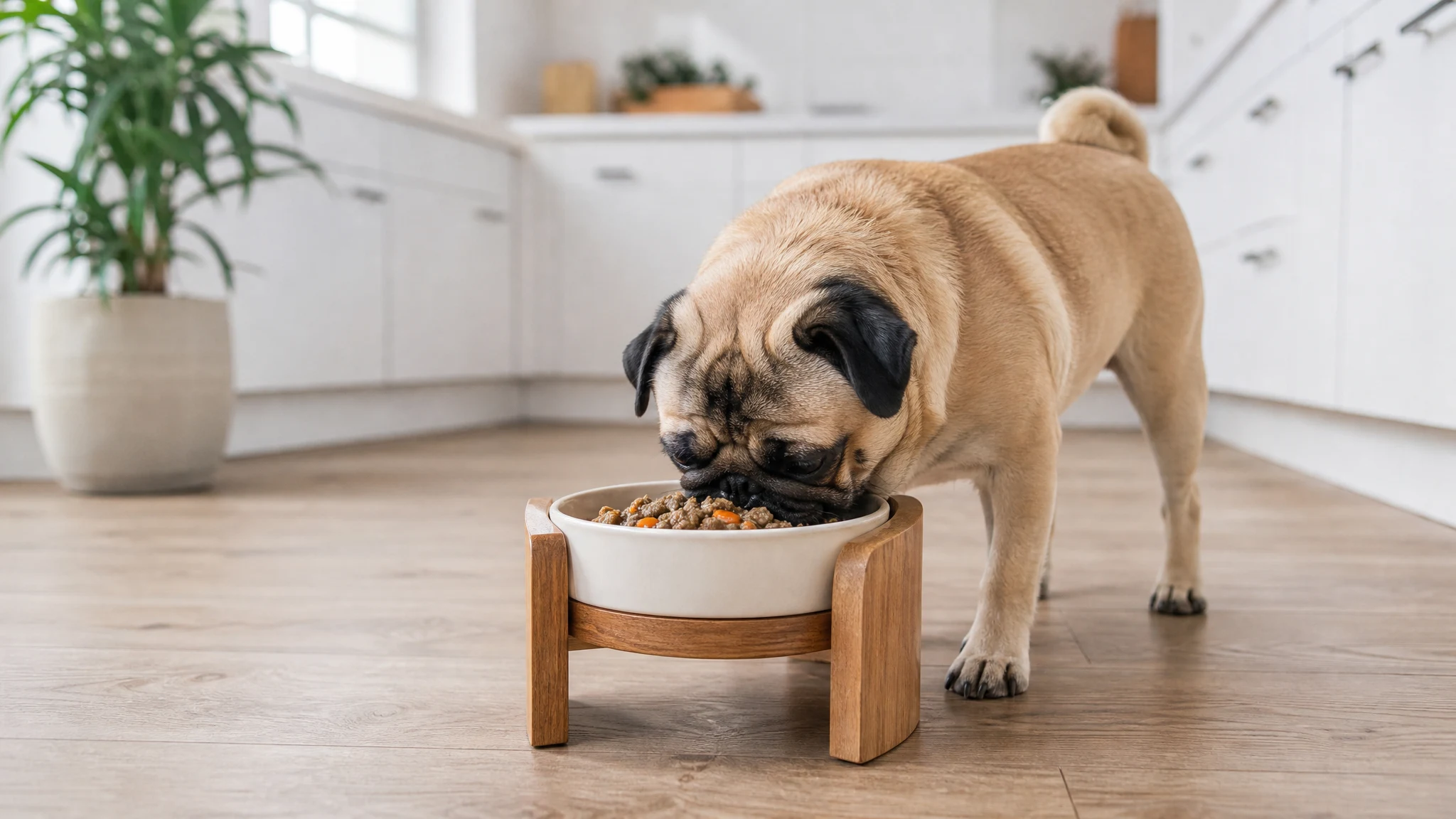
Pugs love food and gain weight easily. Obesity appears on the Orvis Pug breed page among the breed's common health issues. So the amount in the bowl matters more for this breed than for many others.
This guide shows how to turn a food label's feeding guide into a daily amount for your adult Pug. It includes a small pug feeding chart built from the label data of several foods. For a broader view by age, see our Pug feeding chart by age and weight.
What to Know Before You Start
Orvis lists the average adult Pug at 14 to 18 pounds. Your dog may be above or below that range, and a dog's frame matters as much as the number on the scale. Treat the range as a typical figure, not a target.
There is no single correct amount for every Pug. Every number below is a starting point taken from a manufacturer's own label guide. Your dog's age, activity, spay or neuter status and health all change the right amount. A veterinarian decides what suits an individual dog.
Materials You Need
- Your dog's food bag or can, with the feeding guide and calorie statement.
- A standard 8 oz measuring cup, or better, a kitchen scale that reads in grams.
- A scale for weighing your dog. A bathroom scale works: weigh yourself, then yourself holding the dog, and subtract.
- A notebook or phone note for tracking weight and portions.
- Your veterinarian's contact details, for questions about body condition.
Step-by-Step: Finding a Daily Amount
Step 1: Weigh your Pug
Use the same scale each time, ideally at the same time of day. Write the weight down. Label guides are organized by weight, so this number is your starting key.
Step 2: Read the feeding guide on the label
Find the table on the bag, can or brand page. Look for your dog's weight and, where the table offers it, an activity level. Most guides give a total for the whole day, not per meal. Check that before you pour.
Step 3: Check the calorie count and the life stage statement
Look for the AAFCO statement. It should say the food is complete and balanced for adult maintenance or for all life stages. Then note the calories per cup or per can. Foods differ a lot here, so a cup of one food is not the same as a cup of another. Never swap foods cup for cup without checking.
Step 4: Compare a few label guides
The table below shows what several brands print on their own pages. We compared label data only. We did not run feeding trials or taste tests, and we did not feed any of these foods to dogs. The rows show that the same dog can get quite different amounts depending on the food.
| Food (brand page) | Calories on label | Label guide example |
|---|---|---|
| Royal Canin Pug Adult Dry | 315 kcal ME per cup | 13 lb, low activity: 1 1/8 cups (92 g) per day. Table covers 13 to 22 lb. |
| Hill's Science Diet Adult Perfect Weight Small & Mini | 298 kcal per cup | No fixed table on the page. It says to adjust amounts to maintain optimal weight and to ask your veterinarian. |
| VICTOR Hi-Pro Plus Small Breed Adult | 360 kcal per cup | 10 lb: 1 cup per day. 30 lb: 2 1/4 cups per day (8 oz cup). |
| Freshpet Small Dog Bite Size Chicken | 267 kcal per cup | Page asks you to select your dog's weight to see the daily amount. |
Notice the gaps. Royal Canin's table starts at 13 lb, which fits many Pugs. The VICTOR examples are for a 10 lb and a 30 lb dog, so a 16 lb Pug falls between them and you would need the full chart on its page. We do not guess at in-between values. Use the full table on the brand's page for your dog's exact weight.
Step 5: Measure the portion accurately
A scoop is not a measure. Level a standard cup, or weigh the food in grams if the label gives grams, as Royal Canin does. Scoops can vary a lot from one to the next, and a heaping cup can hold noticeably more food than a level one.
Step 6: Divide the day's food into meals
The pages we compared give daily totals and do not set a meal schedule. Many owners split the daily amount into two meals. Ask your veterinarian what schedule fits your dog, especially for a dog with a health condition. Keep meal times steady from day to day.
Step 7: Count treats and extras
Treats, chews, table scraps and food used for training all add calories. Hill's and VICTOR both tell owners to adjust amounts to keep the dog in good body condition. If your Pug gets many treats, take a little from the meal portion. Ask your veterinarian how much to trim.
Step 8: Weigh and check body condition every few weeks
Write down your Pug's weight. Look from above for a waist and feel along the ribs. You should be able to feel them under a light covering of flesh. If your dog is gaining or losing, adjust the portion in small steps and recheck. If you are unsure what a healthy shape looks like, ask your veterinarian to show you at the next visit.
Tips for Pug Owners
- Start from the label, then let the dog decide. A label guide is a starting point. Real portions come from watching weight and body shape over time.
- Use the activity column. Royal Canin's adult guide splits amounts by low, medium and high activity. Many Pugs are low to moderate in activity, but judge your own dog honestly.
- Be wary of the bowl-plus-begging cycle. Pugs are very good at asking for more. A steady routine helps.
- Use a weight-management food only on a veterinarian's advice. Some foods, such as Hill's Perfect Weight, are made for dogs who need to manage weight. Whether your dog needs one is a veterinary decision.
- Switch foods gradually. Mix the new food into the old over several days, and ask your veterinarian if your dog has a sensitive stomach.
Common Mistakes to Avoid
- Eyeballing the scoop. Small errors add up fast in a 14 to 18 pound dog. Extra food worth a few kibbles a day matters more in a small body.
- Using a puppy or all-life-stages amount for an adult. Puppy foods are richer. Royal Canin's Pug Puppy food, for example, lists 369 kcal per cup against 315 for its Pug Adult. Match the food and its guide to your dog's life stage.
- Copying another dog's portion. A friend's Pug may have different weight, age and activity.
- Ignoring calories when changing brands. The same cup can hold quite different calories. VICTOR's small breed adult lists 360 kcal per cup, while Freshpet's small dog recipe lists 267.
- Forgetting that fresh and canned foods are measured differently. Royal Canin's canned Mature 8+ lists calories per can, not per cup. Read the unit before comparing.
- Treating a food as a cure. No food prevents or treats a disease on its own. Diet is one part of care, and your veterinarian guides the rest.
What to Expect
If you measure carefully and track weight, many owners find their Pug's weight becomes steadier within a few weeks. Results vary by dog, and a steady weight is not guaranteed.
Weight is also worth watching because of the breed's short muzzle. In a June 2026 press release, the Texas A&M College of Veterinary Medicine described a clinical trial in short-muzzled dogs, including a Pug. Dogs that reached an ideal weight showed improvements. The trial is ongoing and its results are early, so this does not show that weight loss will fix breathing problems. It is one more reason to talk with your veterinarian about your dog's weight.
When to Check With Your Veterinarian
Confirm amounts with your veterinarian before you rely on any chart if your Pug:
- has a health condition, such as breathing trouble, joint problems or a history of weight issues;
- is pregnant, nursing, or recovering from illness or surgery;
- is losing or gaining weight even though you are following the guide;
- is a senior. Royal Canin's Mature 8+ and Hill's Adult 11+ are labeled for older small dogs, and your veterinarian can say whether your dog needs one.
Orvis lists hip dysplasia, patellar luxation and an elongated palate among the Pug's health concerns. Some of these may be affected by body weight, and a veterinarian can tell you how. Diet will not manage every one of them.
Our sources do not give a size category or the age at which a Pug counts as an adult, so ask your veterinarian or check with the American Kennel Club or the Pug Dog Club of America. The Royal Canin Pug formula uses 10 months as its adult cutoff, which is one manufacturer's choice.
Quick Recap
- Weigh your Pug.
- Find the daily amount in the label guide for your dog's weight and activity.
- Check calories and the AAFCO life stage statement.
- Measure with a level cup or a scale.
- Split the day's food into steady meals, as your veterinarian advises.
- Count treats.
- Recheck weight and body shape every few weeks, and adjust in small steps.
Sources
- Orvis Pug breed page
- Texas A&M College of Veterinary Medicine press release, June 16, 2026
- Royal Canin Pug Adult Dry Dog Food
- Royal Canin Pug Puppy Dry Dog Food
- Royal Canin Mature 8+ Loaf in Sauce
- Hill's Science Diet Adult Perfect Weight Small & Mini
- Hill's Science Diet Adult 11+ Small & Mini
- VICTOR Hi-Pro Plus Small Breed Adult
- Freshpet Small Dog Bite Size Chicken Recipe