Pug Feeding Chart by Age: From Puppy to Senior
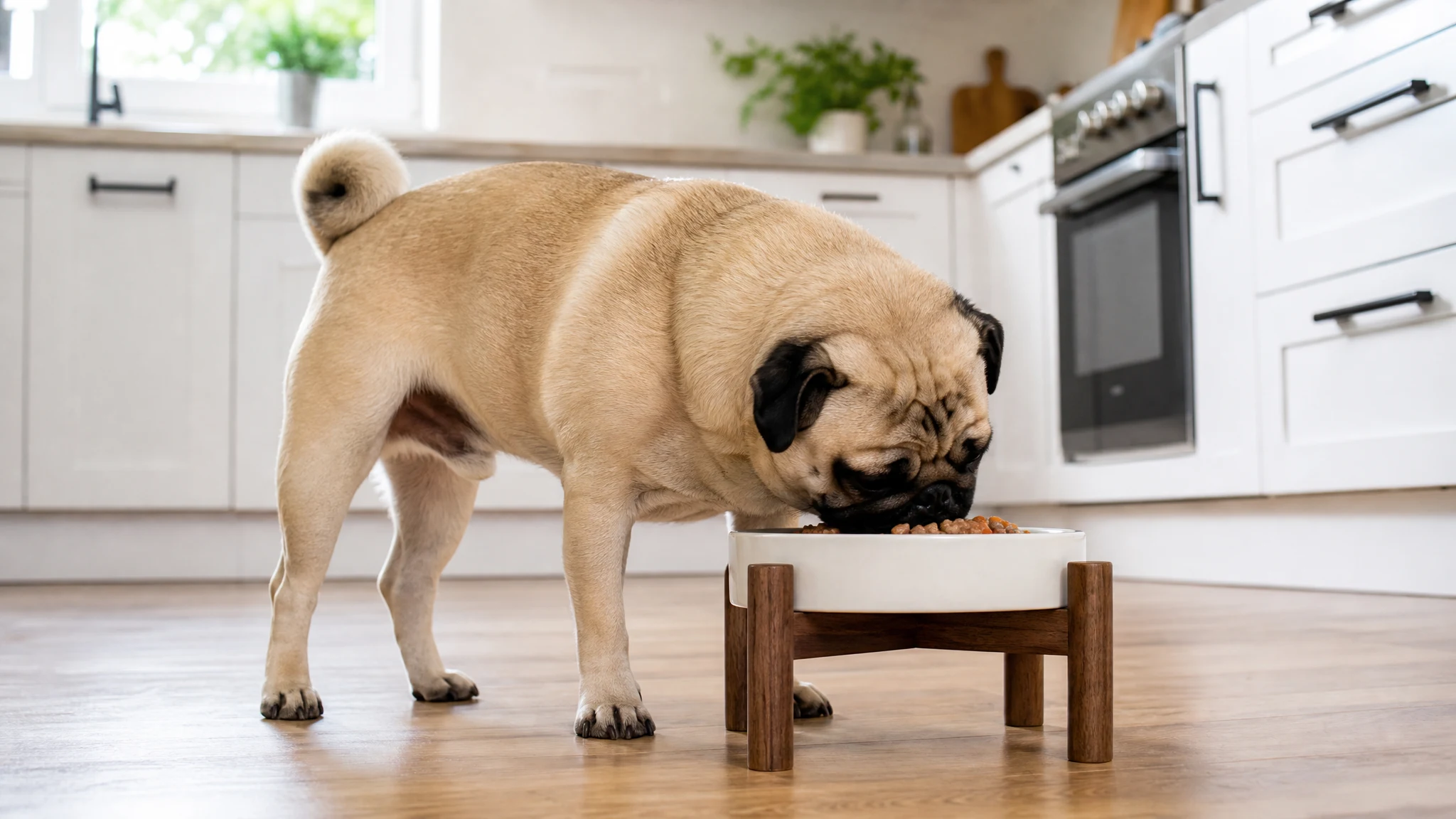
General nutrition information compiled from product labels and published sources, not veterinary advice. Your veterinarian is the right person to choose a diet for your dog, especially one with a health condition.
Pugs are small, food-motivated dogs, and they gain weight easily. Orvis lists obesity among the common Pug health issues. A good pug feeding chart by age gives you a starting point, not a final answer.
This guide shows how to build that chart for your own dog. We compared label data from the brands' own pages. We did not run feeding trials or taste tests, so treat everything here as a way to read labels, not as a ranking.
What You Need Before You Start
- A complete and balanced food that carries an AAFCO statement for your dog's life stage.
- A dry measuring cup or a kitchen scale. Scoops and coffee mugs vary a lot.
- Your dog's current weight. A bathroom scale works: weigh yourself, then weigh yourself holding your dog, and subtract.
- The feeding table from the food's own page or bag.
- A notebook or phone note for weight and portion changes.
- Your veterinarian's contact details. You will want them for the final check on amounts.
Pug Basics That Shape the Chart
Orvis gives the average adult Pug weight as 14 to 18 pounds and life expectancy as 13 to 15 years. It lists obesity, hip dysplasia and an elongated palate among the breed's health concerns. Treat these as typical ranges. Your dog may sit outside them.
A Pug is a small dog. That means large-breed growth formulas are not the target for this breed. Look for small-breed, Pug-specific or all-life-stage foods instead.
The Pug Feeding Chart by Age at a Glance
The table below uses the life-stage ranges the brands themselves print. Age cutoffs differ by brand, so read the page for the food you actually buy.
| Life stage | What the brands say | Label calories to know |
|---|---|---|
| Puppy | Royal Canin lists its Pug Puppy formula for purebred Pugs from 8 weeks to 10 months. Hill's lists its Small & Mini puppy food for dogs up to 1 year. | Royal Canin Pug Puppy: 369 kcal per cup. Hill's Puppy Small & Mini: 418 kcal per cup. |
| Adult | Royal Canin lists its Pug Adult formula for purebred Pugs 10 months and older. | Royal Canin Pug Adult: 315 kcal per cup. Hill's Adult Perfect Weight Small & Mini: 298 kcal per cup. |
| Senior | Hill's lists its Adult 11+ Small & Mini food for adult dogs 11 years and older. Royal Canin's Mature 8+ canned food is aimed at small breeds over 8 years. | Hill's Adult 11+ Small & Mini: 378 kcal per cup. Royal Canin Mature 8+ canned: 145 kcal per can. |
Notice that one cup of one food is not the same as one cup of another. The calorie gap between a 298 kcal cup and a 418 kcal cup is large. This is why you should never swap foods cup for cup.
For a deeper look at portions by weight, see our Pug feeding chart by age and weight.
Step-by-Step: Build Your Pug's Feeding Plan
Step 1: Pick the life stage that matches your dog
Start with age. Then check the AAFCO statement on the food. It should say the food is formulated for growth, maintenance or all life stages.
Some labels add that the food is not meant for growth of large-size dogs (70 pounds or more as an adult). That exclusion does not matter for a Pug. It simply reflects the food's design.
Step 2: Read the label data, not the front of the bag
Marketing words such as "premium" or "natural" are not nutrient measures. Look at three things instead: the AAFCO statement, the first few ingredients, and the calories per cup.
For example, Royal Canin's Pug Adult page lists brewers rice, brown rice, oat groats, chicken by-product meal and corn as its first five ingredients. VICTOR's Hi-Pro Plus Small Breed Adult lists beef, chicken meal, beef meal, brown rice and whole grain millet. Both are labeled grain-inclusive. Ingredient order alone does not tell you which dog will do better on a food.
Step 3: Find the starting amount on the brand's own table
Every amount below is a label guide, not a prescription. Use it only as a starting point.
- Puppy: Royal Canin's Pug Puppy table is organized by age (2 to 10 months) and expected adult weight (13, 18 or 22 pounds). A 2-month-old puppy with a 13 pound expected adult weight is listed at 1 1/8 cups (105 grams) per day.
- Adult: Royal Canin's Pug Adult table covers 13 to 22 pound dogs by low, medium and high activity. A 13 pound, low-activity dog is listed at 1 1/8 cups (92 grams) per day. The page also offers a calculator.
- Adult, all-life-stage option: VICTOR's Hi-Pro Plus Small Breed Adult chart uses an 8 ounce measuring cup. It lists 1 cup daily for a 10 pound dog.
- Hill's foods: The Hill's pages say to adjust feeding amounts as necessary to maintain optimal weight, and to ask your veterinarian if unsure.
Check the brand's page for the exact row that matches your dog's weight and activity. The pages for Royal Canin, Hill's and VICTOR list the daily totals. Check each page for how many meals to split that total into, or ask your veterinarian.
Step 4: Weigh the food
A scale is more accurate than a cup. Royal Canin's tables list grams next to cups for this reason. Weigh the daily amount, then divide it into meals.
Step 5: Count treats and chews
Treats, chews and table scraps add calories on top of the table amount. If your dog eats treats, ask your veterinarian how much to trim from meals. Do not guess.
Step 6: Weigh, check body shape and adjust
Weigh your Pug every two to four weeks while you settle on an amount. Then check monthly. If your Pug is gaining or losing more than expected, change the portion in small steps and tell your veterinarian.
Growing puppies gain weight on purpose, so a puppy's numbers will climb. An adult's numbers should hold steady.
Step 7: Change life stage gradually
When your Pug moves from puppy to adult food, or from adult to senior, switch over several days. Mix a little of the new food into the old, then shift the ratio each day. Watch stools and appetite. If something seems off, pause and call your veterinarian.
Life-Stage Notes for Pugs
Puppies
Puppy foods are higher in calories per cup. Royal Canin's Pug Puppy label lists a 27 percent protein minimum and a 16 percent fat minimum. Its kibble is shaped for the Pug's short, square muzzle, although no kibble dimensions are given. Hill's does not describe kibble size on its puppy page. If a brand does not give a size, check with the brand before you buy a large bag.
Adults
Adulthood is where weight control matters most. The Hill's Adult Perfect Weight Small & Mini food is positioned for weight management and lists 298 kcal per cup. A weight-management food is a veterinarian-level decision, so ask before switching.
The Texas A&M College of Veterinary Medicine announced a clinical trial in short-muzzled dogs, including a Pug, in a June 16, 2026 press release. It reports improvements in dogs that reached ideal weight, and the trial is still ongoing. That is early information, not proof that weight loss fixes breathing problems. Still, it is a good reason to talk to your veterinarian about your dog's ideal weight.
Seniors
Hill's lists its Adult 11+ Small & Mini food as nibble-size kibble at 378 kcal per cup. Royal Canin's Mature 8+ canned food lists 145 kcal per can, as a per-can rather than per-cup figure. Older Pugs may eat less or have dental issues, so food form and portion are worth reviewing with your veterinarian at each checkup.
Common Mistakes to Avoid
- Free-feeding. Leaving food out all day makes it hard to track intake.
- Using the wrong cup. VICTOR's chart specifically assumes an 8 ounce measuring cup.
- Swapping foods cup for cup. Calories per cup differ widely, as the table shows.
- Ignoring treats. They count toward the day's total.
- Adding supplements on your own. A complete and balanced food already supplies what the AAFCO profile requires. Ask your veterinarian before adding anything.
- Choosing a food by DCM headlines. The FDA's investigation page was last updated December 23, 2022, and the agency said it would not post more updates until there is meaningful new scientific information. Talk to your veterinarian rather than reacting to a headline.
- Treating a food as a treatment. No food on this page is a treatment for hip dysplasia, allergies or any other condition.
What to Expect
With steady measuring and regular weigh-ins, many owners find it easier to keep a Pug at a stable, healthy weight. Stools and energy usually settle within a couple of weeks of a gradual food change, though every dog differs.
Results depend on your dog's age, activity, health and the food you choose. A Pug with a health condition may need a different amount or a veterinary diet. Confirm amounts with your veterinarian, especially for a puppy, a senior or any dog with a medical issue. Brand pages and bag labels can change, so read the current version before you buy.
Sources
- Orvis Pug breed page
- Texas A&M College of Veterinary Medicine press release, June 16, 2026
- FDA CVM: Investigation into Potential Link between Certain Diets and Canine Dilated Cardiomyopathy
- Royal Canin Pug Puppy product page
- Royal Canin Pug Adult product page
- Royal Canin Mature 8+ product page
- Hill's Science Diet Puppy Small & Mini product page
- Hill's Science Diet Adult Perfect Weight Small & Mini product page
- Hill's Science Diet Adult 11+ Small & Mini product page
- VICTOR Hi-Pro Plus Small Breed Adult product page