Pug Puppy Feeding Amounts: Cups Per Day by Age
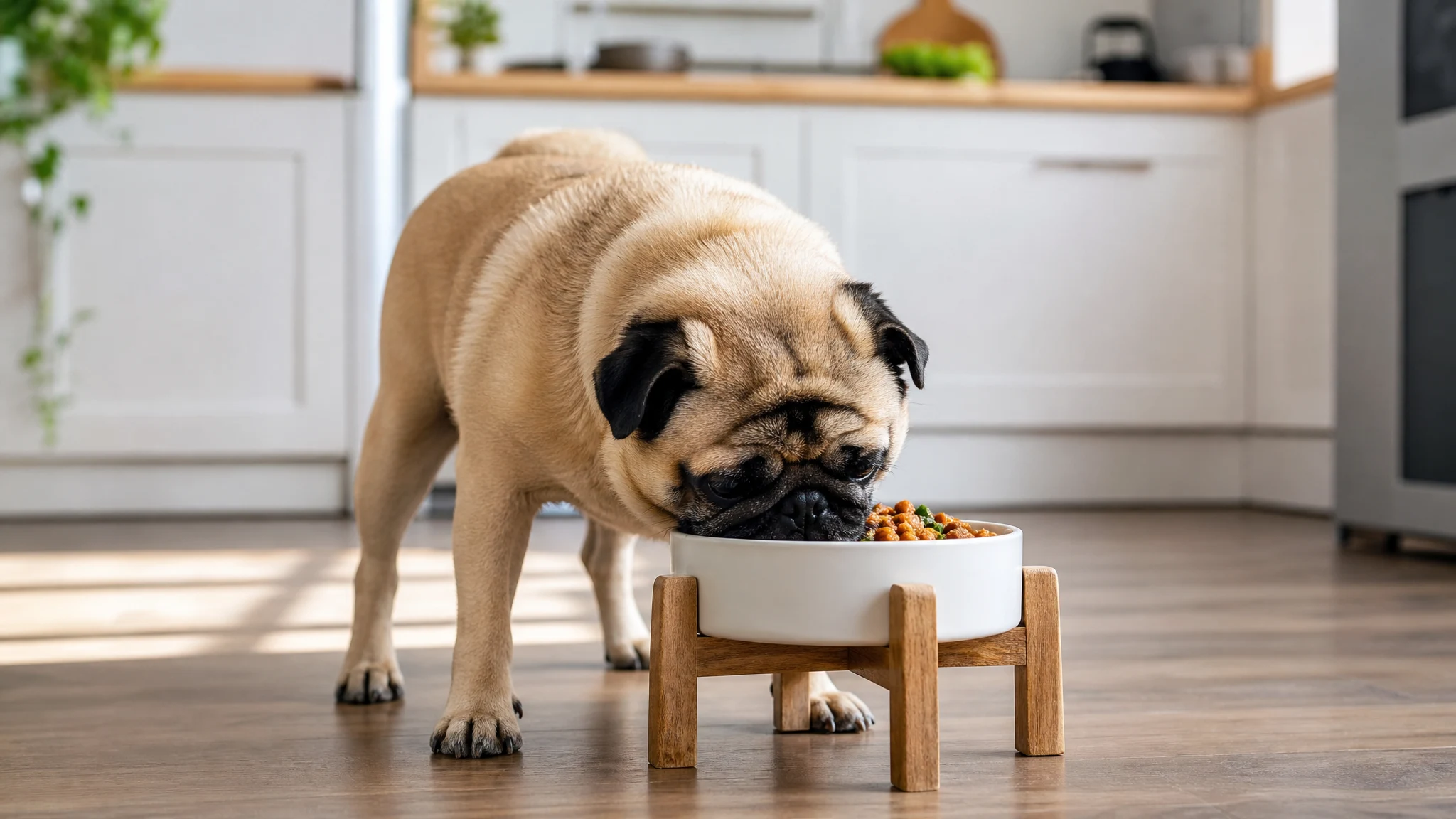
General nutrition information compiled from product labels and published sources, not veterinary advice. Your veterinarian is the right person to choose a diet for your dog, especially one with a health condition.
Working out how much to feed a Pug puppy is mostly a matter of reading one table on the bag and then watching your puppy's body. No single cups-per-day number fits every Pug, because the right amount depends on the food, the puppy's age, the expected adult weight and how active the puppy is.
This guide walks you through that process step by step. It also shows where the printed feeding guides stop being useful, so you know when to ask your veterinarian instead of guessing.
Why Pug puppies need a careful approach
Pugs are small dogs. The Orvis Pug breed page lists an average adult weight of 14 to 18 pounds and a typical life span of 13 to 15 years. It also lists obesity among the common Pug health issues.
That matters at the food bowl. A few extra kibbles a day add up quickly in a dog this size.
Texas A&M College of Veterinary Medicine announced a clinical trial in short-muzzled dogs, including a Pug, in a June 16, 2026 press release. It looks at whether reaching an ideal weight improves breathing. The trial is still ongoing, so there are no firm conclusions yet. It is one more reason to keep a growing Pug lean and not overfeed.
What you need before you start
- The bag or can of the food you plan to feed, with the full feeding guide and the calorie statement.
- A standard dry measuring cup. A kitchen scale is even better, since several labels list grams as well as cups.
- Your puppy's current weight and age.
- An estimate of your puppy's adult weight. Your breeder or veterinarian can help with this.
- A notebook or phone note to log meals and weight checks.
Step 1: Check that the food is made for puppies
Look for the AAFCO statement on the label. For a growing Pug, it should say the food is formulated for growth, or for all life stages. Be careful with all-life-stages foods. Some carry an exception for growth of large-size dogs (70 pounds or more as an adult). A Pug is not a large-size dog, so that exception does not affect a Pug puppy.
Here is how the label data compares for a few foods. We compared label data from each brand's own page. We did not run feeding trials or taste tests.
| Food | Label statement | Calories listed |
|---|---|---|
| Royal Canin Pug Puppy Dry | Meets AAFCO profiles for growth, including growth of large-size dogs | 369 kcal ME per cup |
| Hill's Science Diet Puppy Small & Mini Chicken & Brown Rice | AAFCO feeding tests for growing puppies | 418 kcal per cup |
| VICTOR Hi-Pro Plus Small & Medium Breed Puppy | AAFCO all life stages, except growth of large-size dogs | 383 kcal per cup |
| Freshpet Small Dog Bite Size Chicken | AAFCO all life stages, except growth of large-size dogs | 267 kcal per cup |
Notice the spread. A cup of the Hill's puppy food lists 418 kcal, while a cup of the Freshpet recipe lists 267 kcal. The same cup of food does not give the same energy, so a cups-per-day number from one brand cannot be moved to another.
Step 2: Find the feeding table for your puppy's age and adult weight
Every brand organizes its guide a little differently, so read yours closely.
- Royal Canin Pug Puppy: the Royal Canin product page lists a daily table by puppy age (2 to 10 months) and target adult weight (13, 18 or 22 pounds). For example, it lists 1 1/8 cups (105 g) per day for a 2-month-old puppy with a 13 pound target adult weight.
- Hill's Science Diet Puppy Small & Mini: the Hill's product page tells you to adjust amounts as needed to maintain optimal weight and to ask your veterinarian if you are unsure.
- VICTOR Hi-Pro Plus Small & Medium Breed Puppy: the VICTOR product page organizes its guide by age group and body weight and says to use it as a guide.
- Freshpet Small Dog Bite Size Chicken: the Freshpet product page asks you to select your dog's weight to see a normal daily amount.
Find the row that matches your puppy's age and expected adult weight. Read across to the daily total. That number is your starting point, not a target to hit exactly.
We are not printing a full cups-per-age chart here. The brands publish different tables, and a number that is right for one food can be wrong for another. If the label gives no figure for your puppy's age, check with the brand or your veterinarian. For a general overview, see our Pug feeding chart by age and weight.
Step 3: Measure the daily total accurately
Use the same measuring cup every time. Scoop and level it, without packing or heaping. If the label lists grams, weigh the food on a scale for the most consistent result. Cups can vary a lot, especially with small kibble.
Measure the full day's food in the morning, if you can. Then split it into the meals you feed. This keeps you from losing count when more than one person feeds the puppy.
Step 4: Split the daily total into meals
The feeding guides above give a daily total. The sources we relied on do not set a meal count for Pug puppies. Ask your veterinarian how many meals a day suit your puppy's age, and keep mealtimes steady once you settle on a plan.
Treats count toward the day. If you use training treats, take a small amount out of the measured meals so the total stays about the same.
Step 5: Check your puppy's body every week
The label table is only a starting point. Your puppy's body tells you more.
- Look down from above. You should see a gentle waist behind the ribs.
- Run your hands along the ribs. You should be able to feel them under a thin layer of padding without pressing hard.
- Weigh your puppy at the same time each week and write down the result.
Pugs are stocky, so a round shape can hide extra weight. If you are unsure what a healthy build looks like, ask your veterinarian to show you at a checkup.
Step 6: Adjust slowly and change the food gradually
If your puppy is gaining too fast, trim the portion a little and recheck in a week. If your puppy seems thin or hungry all the time, talk to your veterinarian before increasing the food. Make small changes, not big jumps.
When you switch brands, mix the new food into the old over several days. Different foods have different calorie counts per cup, so recalculate the portion from the new label.
Step 7: Plan for the move to adult food
Royal Canin lists its Pug Puppy formula for purebred Pugs from 8 weeks to 10 months, and its Pug Adult formula for 10 months and older. Other brands set their own life-stage ranges. Ask your veterinarian when to switch your puppy, and use the new food's own label for the portion.
Common mistakes to avoid
- Eyeballing the scoop. A heaped cup can hold noticeably more food than a level one.
- Using one brand's cups with another brand's food. Calories per cup differ widely.
- Forgetting treats and chews. They add calories that the label table does not account for.
- Feeding to the bowl, not the body. A puppy that begs is not always a puppy that needs more.
- Adding supplements on your own. A complete and balanced food already covers the basics. Ask your veterinarian before adding anything, and follow their directions.
- Assuming a food will fix a health problem. Diet is one part of care. Your veterinarian decides what is right for an individual dog.
Tips that help
- Keep a simple log of meals, treats and weekly weights.
- Use part of the daily kibble as training rewards.
- Keep the feeding guide from the bag, or save the product page, so you can recheck it as your puppy grows.
- Remember that the guides say "adjust to maintain good body condition." That is a real instruction, not boilerplate.
If your puppy has a health condition
Pugs have several health concerns, including brachycephalic airway problems such as an elongated palate, hip dysplasia and others. A puppy with a diagnosed condition, or one that is underweight or overweight, may need an amount that differs from the label. Confirm the amount with your veterinarian. Prescription diets are something only a veterinarian prescribes.
The FDA has an investigation page on possible links between certain diets and canine dilated cardiomyopathy (DCM). Its latest update is dated December 23, 2022, and the FDA says it will not release further public updates until there is meaningful new scientific information. If you have questions about a particular diet, bring them to your veterinarian.
What to expect
If you follow the label's starting amount and adjust by your puppy's body condition, your puppy may grow at a steady pace and keep a visible waist. Results vary from dog to dog. Appetite, activity, treats and individual metabolism all play a part.
Expect to adjust the amount several times as your puppy grows. Weekly weight checks and regular veterinary visits will show you whether the plan is working.
Sources
- Royal Canin US: Pug Puppy Dry Dog Food
- Hill's Pet: Science Diet Puppy Small & Mini Chicken & Brown Rice Recipe
- VICTOR: Hi-Pro Plus Small & Medium Breed Puppy
- Freshpet: Small Dog Bite Size Chicken Recipe
- Orvis: Pug breed page
- Texas A&M College of Veterinary Medicine: press release, June 16, 2026
- FDA CVM: Investigation into Potential Link between Certain Diets and Canine Dilated Cardiomyopathy