Pug Puppy Food: How Much and How Often to Feed
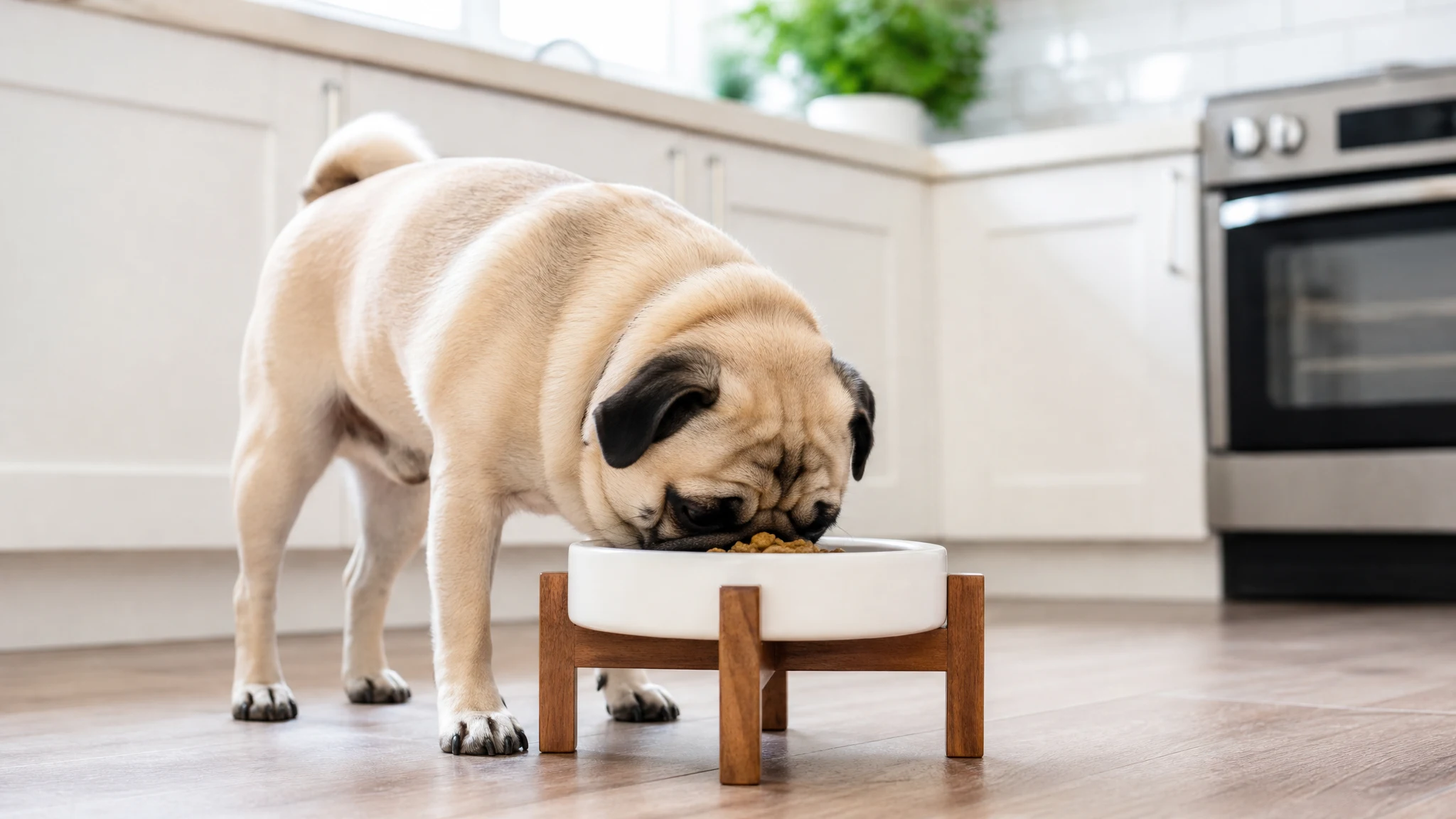
General nutrition information compiled from product labels and published sources, not veterinary advice. Your veterinarian is the right person to choose a diet for your dog, especially one with a health condition.
Feeding a Pug puppy is mostly a measuring job. The food bag gives a starting amount, your puppy's body tells you if it is right, and your veterinarian settles the details. This guide walks through that process in order.
Pugs are small dogs. Orvis lists the average adult weight at 14 to 18 pounds, and it lists obesity among the breed's common health issues. That is why careful portions matter from the first weeks.
What You Need Before You Start
- The complete and balanced puppy food your puppy is eating, with the bag or the brand's product page handy.
- A dry measuring cup, or better, a kitchen scale that reads in grams.
- A notebook or phone note for daily amounts and weekly weights.
- A scale for weighing your puppy. A bathroom scale works if you weigh yourself holding the puppy, then subtract your own weight.
- Your veterinarian's phone number, for questions about your own puppy.
Step 1: Check That the Food Is Made for Growth
Start with the AAFCO statement on the label. For a puppy, you want wording that says the food meets the AAFCO Dog Food Nutrient Profiles for growth or for all life stages. A food labeled only for adult maintenance is not built for a growing puppy.
Here is what the brand pages say about a few foods. We compared label data from these pages. We did not run feeding trials or taste tests.
| Food | AAFCO wording (per brand page) | Calories listed |
|---|---|---|
| Royal Canin Pug Puppy Dry | Growth, including large size dogs | 369 kcal ME per cup |
| Hill's Science Diet Puppy Small & Mini Chicken & Brown Rice | Growth and gestation or lactation, by AAFCO feeding tests | 418 kcal per cup |
| VICTOR Hi-Pro Plus Small & Medium Breed Puppy | All life stages, except growth of large size dogs | 383 kcal per cup |
Notice that the calories per cup differ by more than 10 percent between the highest and lowest. One cup of one food is not the same as one cup of another. This is the main reason you should never copy a friend's measured amount.
Step 2: Find the Feeding Guide for Your Exact Food
Every complete puppy food has its own feeding guide, and the guide is the starting point. Each brand builds its table differently:
- Royal Canin Pug Puppy: the brand's product page lists a daily table by puppy age (2 to 10 months) and expected adult weight (13, 18 or 22 pounds). A 2-month-old with a 13 pound expected adult weight is listed at 1 1/8 cups (105 g) per day.
- VICTOR Hi-Pro Plus Small & Medium Breed Puppy: the brand's page organizes its guide by age group and body weight, and says to use it as a guide.
- Hill's Science Diet Puppy Small & Mini: the brand's page says to adjust amounts as necessary to maintain optimal weight, and to ask your veterinarian if you are unsure.
Read the table by age and expected adult weight, not just by today's weight. If your puppy's breeder or veterinarian expects an adult weight near the Pug average of 14 to 18 pounds, use the closest column. If you are unsure which column fits, ask your veterinarian rather than guessing.
For a broader look at portions across life stages, see our Pug feeding chart by age and weight.
Step 3: Measure the Daily Total
- Look up the daily amount in the guide for your puppy's age and expected adult weight.
- Weigh the food on a kitchen scale if you can. A scoop can hold noticeably more or less than the label's cup, depending on how it is packed.
- If you use a cup, level it off. Do not heap it.
- Write the daily total in your notebook.
The number in the guide is a total for the whole day, not the amount for one meal. Treats, chews and any food used for training come out of the same day's allowance.
Step 4: Split the Day Into Meals
The brand pages we reviewed give daily totals. They do not tell you a set number of meals, and we have no breed source that does. Many puppy owners divide the daily total into several small meals, but your veterinarian can tell you the right number for your puppy's age and health.
Whatever schedule you and your veterinarian choose, a few habits help:
- Divide the measured daily total evenly across the meals, so each portion is measured ahead of time.
- Feed at similar times each day. A steady routine makes it easier to notice a puppy who suddenly eats less.
- Leave the bowl down for a short, set time, then pick it up. Free feeding makes it harder to know how much was eaten.
Step 5: Weigh Weekly and Look at the Body
The guide is a starting amount. Your puppy's weight and shape show whether it is working.
- Weigh your puppy once a week and write it down.
- Look from above. A healthy waist should be visible behind the ribs.
- Run your hands along the ribs. You should be able to feel them under a thin layer of padding, without pressing hard.
Pug puppies are round and wrinkly, which can hide extra weight. Hands tell you more than eyes. Your veterinarian can show you how to score body condition at a checkup.
Step 6: Adjust Slowly, With Your Veterinarian
If your puppy seems to be gaining too fast or too slowly, make a small change to the daily total and recheck in a week or two. Do not change amounts sharply, and do not change foods suddenly. Switching foods over several days by mixing old and new is the usual approach, and your veterinarian can advise on the pace.
Confirm amounts with your veterinarian if your puppy has any health condition, a history of stomach upset, or an unusual growth pattern. Do not add supplements to a complete and balanced puppy food unless a veterinarian tells you to.
Common Mistakes to Avoid
- Feeding by cups from another brand. Cup amounts only work for the food they were written for, because calories per cup vary.
- Forgetting treats. Small treats add up fast for a 14 to 18 pound adult-to-be. Count them in the daily allowance.
- Using an adult guide for a puppy. Adult tables, such as Royal Canin's Pug Adult table for 13 to 22 pound dogs, assume a different calorie need.
- Choosing a large-breed puppy food. Pugs are small dogs, so a formula designed to slow growth in very large dogs is not aimed at them. Ask your veterinarian if you are unsure.
- Trusting the guide over the puppy. If the puppy is getting heavy while eating the listed amount, the amount is too much for that puppy.
- Making every begging look a reason to feed. Pugs are skilled at asking for food. Reward good behavior with praise or play, or with a few pieces of the measured kibble.
Why Weight Control Starts Early
Extra weight is a known concern in Pugs. A June 2026 Texas A&M College of Veterinary Medicine press release describes an ongoing clinical trial in short-muzzled dogs, including a Pug. It says dogs that reached an ideal weight showed improvements in breathing. The trial was still ongoing at the time of the release, so it does not show that weight loss fixes breathing problems in any one dog.
What it does support is a sensible habit: keep a short-muzzled puppy lean as it grows, and talk to your veterinarian about any noisy or labored breathing.
What Results to Expect
If you follow these steps, you may see a puppy that grows steadily, keeps a visible waist and has regular, firm stools. Individual puppies vary, and results depend on age, activity, genetics and health. A well-chosen puppy food and measured portions can support healthy growth, but they cannot promise any particular outcome.
If your puppy refuses meals, has loose stools that last more than a day or two, vomits, or shows labored breathing, contact your veterinarian. Do not wait for the next weigh-in.
Quick Recap
- Pick a complete and balanced food labeled for growth or all life stages.
- Find that food's own feeding guide by age and expected adult weight.
- Measure the daily total, ideally by weight.
- Divide it into meals on a schedule your veterinarian approves.
- Weigh weekly and check the waist and ribs.
- Adjust in small steps and confirm with your veterinarian.
For the brand details we did not cover here, such as kibble size, check the brand's own page or ask the company. Several of the pages we reviewed do not state kibble dimensions.
Sources
- Royal Canin US: Pug Puppy Dry Dog Food
- Royal Canin US: Pug Adult Dry Dog Food
- Hill's Pet: Science Diet Puppy Small & Mini Chicken & Brown Rice Recipe
- VICTOR: Hi-Pro Plus Small & Medium Breed Puppy
- Texas A&M College of Veterinary Medicine press release, June 16, 2026
- Orvis Pug breed page (secondary source for typical weight and health concerns)