Puppy Food for Pugs: A Feeding Amount Guide by Week
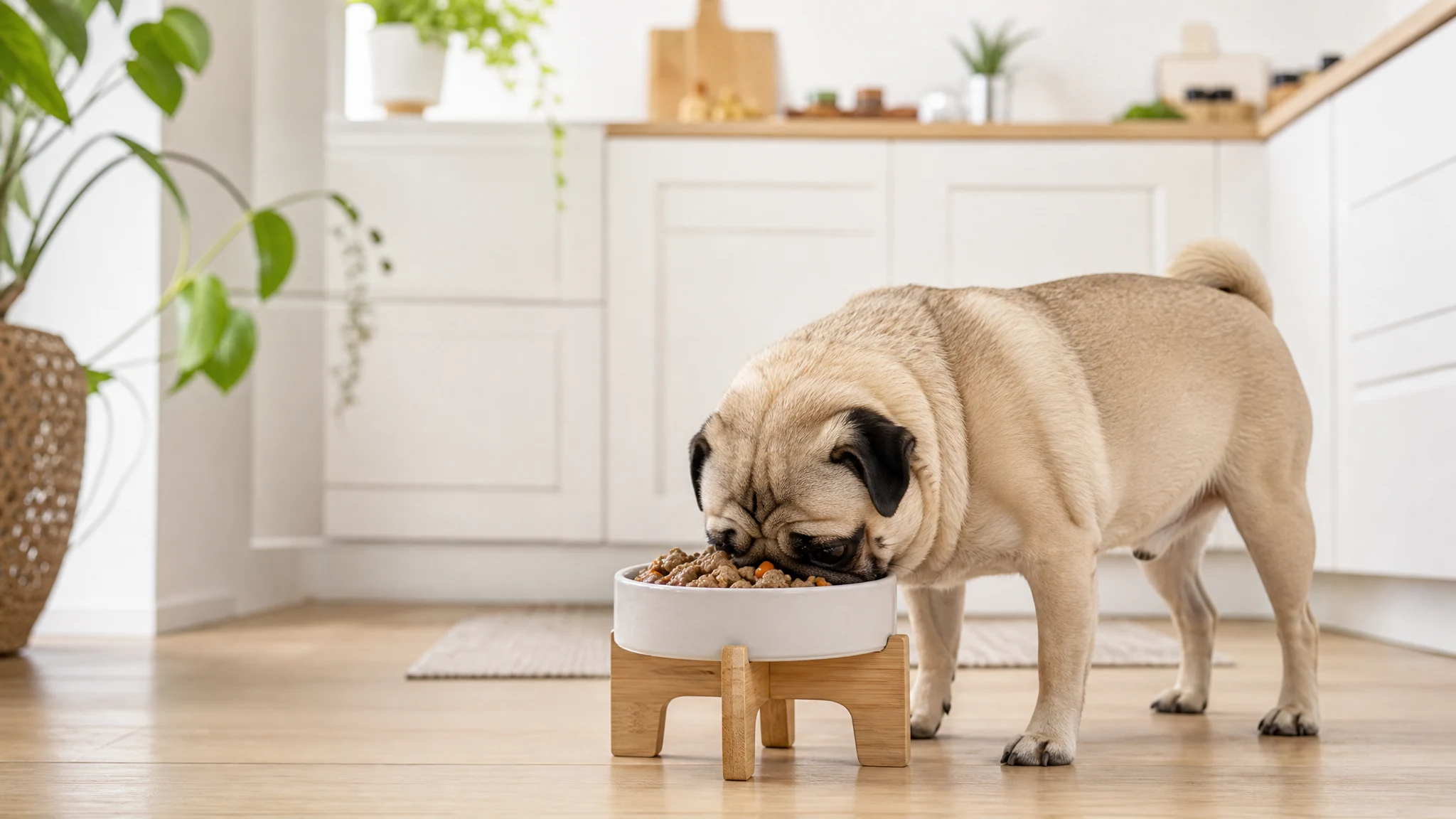
General nutrition information compiled from product labels and published sources, not veterinary advice. Your veterinarian is the right person to choose a diet for your dog, especially one with a health condition.
Feeding a Pug puppy is mostly a matter of reading the label, measuring the food and watching the dog. Pugs are small, and the Orvis Pug breed page lists obesity among their common health issues. Small mistakes in portions add up quickly.
This guide shows how to choose the best puppy food for Pugs, find a starting amount, and adjust it as your puppy grows. It does not give a made-up gram figure for every week. Brands publish their own tables, and those tables should be your starting point.
What you need before you start
- A complete and balanced puppy food, or an all life stages food, with an AAFCO statement on the bag.
- A kitchen scale (grams) or a standard 8 oz measuring cup.
- The brand's feeding table or calculator for your puppy's age and expected adult weight.
- A notebook or phone note for weekly weights and portions.
- A shallow bowl, so a flat-faced puppy can reach the food comfortably.
- Your veterinarian's contact details, because they decide what is right for an individual dog.
Know your Pug's size first
According to the Orvis Pug breed page, adult Pugs average 14 to 18 pounds. Life expectancy is listed as 13 to 15 years. Those are typical ranges, not promises for your dog.
This matters because feeding tables are often built around expected adult weight. The Royal Canin Pug Puppy table, for example, lists target adult weights of 13, 18 or 22 pounds. Pick the column closest to what your breeder or vet expects for your puppy.
Step 1: Pick a puppy food by reading labels
Look for the AAFCO statement first. It should say the food is complete and balanced for growth, or for all life stages. Then compare calories, ingredients and the guaranteed analysis.
We compared label data from the brand pages. We did not run feeding trials or taste tests, so none of this is a ranking of how dogs do on each food. Here is what the labels say:
| Food | Calories | Protein / fat (as labeled) | First ingredient |
|---|---|---|---|
| Royal Canin Pug Puppy (dry) | 369 kcal ME per cup | 27% min / 16% min | Chicken by-product meal |
| Hill's Science Diet Puppy Small & Mini Chicken & Brown Rice (dry) | 418 kcal per cup | 28.9% / 19.7% (average, dry matter basis) | Chicken |
| VICTOR Hi-Pro Plus Small & Medium Breed Puppy (dry) | 383 kcal per cup | 30% min / 18% min | Beef |
| Freshpet Small Dog Bite Size Chicken Recipe (fresh) | 267 kcal per cup | 16% min / 12% min | Chicken |
Notice that a cup of one food is not a cup of another. Hill's lists 418 kcal per cup and Freshpet lists 267. The same scoop would give very different calories. Never swap foods and keep the same cup measure.
Some details to read closely:
- Royal Canin says its Pug Puppy formula is for purebred Pugs from 8 weeks to 10 months, with a custom kibble shaped for the Pug's short, square muzzle. The page gives no kibble dimensions.
- Hill's lists its protein and fat as dry matter averages, so they are not directly comparable to the minimums on other labels.
- VICTOR's page text and its table disagree on protein. The table shows a 30% minimum, so check the bag in your hands.
- Kibble size is not stated for most of these foods. Ask the brand if size matters for your puppy.
Weight and breathing are the diet-related concerns on the Pug breed page and in the Texas A&M research. Their health concern list also includes hip dysplasia, patellar luxation and Pug Dog Encephalitis. No food on this page is claimed to prevent or treat any of these. Your veterinarian is the person to ask.
Step 2: Find the brand's starting amount
Open the brand's own feeding table or calculator. Match your puppy's age and expected adult weight. Treat the number as a starting point, not a target.
Here is one real example. Royal Canin's Pug Puppy table lists a 2-month-old with a 13 pound target adult weight at 1 1/8 cups (105 g) per day. At 369 kcal per cup, that works out to roughly 415 kcal a day. That is the daily total, not one meal.
The Royal Canin table covers ages 2 to 10 months. Hill's says to adjust amounts to maintain optimal weight and to ask your veterinarian if you are unsure. VICTOR says to use its guide by age group and body weight as a guide only. Freshpet asks you to select your dog's weight to see the daily amount.
For a longer reference by age and weight, see our Pug feeding chart by age and weight.
Step 3: Weigh the food and split it into meals
Weigh the daily amount in grams if you can. Scoops vary by how packed the kibble is, and a small error is a big share of a tiny dog's day.
Divide the daily total into several meals. We do not have a brand-published meal count to quote here, so ask your veterinarian how many meals suit your puppy at each stage. Keep the times steady from day to day.
Step 4: Adjust week by week
Brand tables are set by age, but your puppy is set by body condition. Use a weekly check to decide whether to hold, raise or trim the portion.
Weeks 8 to 12: settling in
Start at the brand's table amount for your puppy's age and expected adult weight. Keep the same food your breeder used for the first days if you can, then switch slowly if you change.
Weeks 12 to about 6 months: steady growth
Weigh weekly. Move to the next row of the feeding table as your puppy ages or gains weight. Do not jump straight to a bigger bowl because the puppy seems hungry.
About 6 to 10 months: watching the waistline
Growth slows, and a Pug can start to get round. Royal Canin's Pug Puppy formula is intended up to 10 months, after which its Pug Adult formula is listed for dogs 10 months and older. Ask your vet when to move to adult food for your dog.
Weekly body check
- Run your hands along the ribs. You should feel them under a thin layer of padding.
- Look from above. There should be a slight waist behind the ribs.
- Look from the side. The belly should tuck up a little, not hang.
- Record the weight and the amount fed.
- If the ribs are hard to feel, ask your vet before changing the portion.
Step 5: Count treats and extras
Treats, chews and training rewards add calories. Use part of the daily kibble as rewards when you can. If you add anything beyond a complete and balanced food, such as a supplement, ask your veterinarian first. Do not guess at amounts.
Tips for Pug puppies
- Use a shallow, wide bowl so the short muzzle reaches the food easily.
- Measure every meal. "Eyeballing" is how most overfeeding starts.
- Change foods slowly and keep notes on stool and appetite.
- Check the calories per cup whenever you change brands.
- Keep a regular weigh-in day, such as every Sunday.
Common mistakes to avoid
- Feeding to the begging. Pugs are skilled at asking for more.
- Using the same cup for a new food. Calories per cup differ widely between brands.
- Ignoring treats. They count toward the daily total.
- Skipping weigh-ins. Weight is the clearest sign a portion is off.
- Trusting marketing claims over the label. "Premium" and "natural" are not nutrient information. The AAFCO statement and the calorie line are.
- Copying a large-breed puppy plan. At 14 to 18 pounds as an adult, a Pug is not a large-size dog.
What results to expect
If the portions fit, your puppy may gain weight steadily, keep a visible waist and hold good energy. Stools may be consistent. That is a sign to hold steady, not a promise.
On weight and breathing, a Texas A&M College of Veterinary Medicine press release dated June 16, 2026 describes an ongoing clinical trial in short-muzzled dogs, including a Pug. It says dogs that reached ideal weight showed improvements. The trial is still running, so it does not show that weight loss will fix breathing problems in any one dog. It does give a good reason to keep a Pug lean.
The FDA's page on its investigation into diets and canine dilated cardiomyopathy shows its latest update on December 23, 2022. The agency says it will not post further public updates until there is meaningful new scientific information. If you are concerned about ingredients, ask your veterinarian.
When to call your vet
If your puppy has a health condition, is gaining too fast or too slowly, or has loud or labored breathing, confirm amounts with your veterinarian before changing anything. Prescription diets are only something a veterinarian prescribes.
Sources
- Orvis Pug breed page (weight, life expectancy and health concerns)
- Texas A&M College of Veterinary Medicine press release, June 16, 2026
- FDA: Investigation into Potential Link between Certain Diets and Canine Dilated Cardiomyopathy
- Royal Canin Pug Puppy Dry Dog Food
- Hill's Science Diet Puppy Small & Mini Chicken & Brown Rice Recipe
- VICTOR Hi-Pro Plus Small & Medium Breed Puppy
- Freshpet Small Dog Bite Size Chicken Recipe