Switching Pug Puppies From Puppy to Adult Food: A Timing Guide
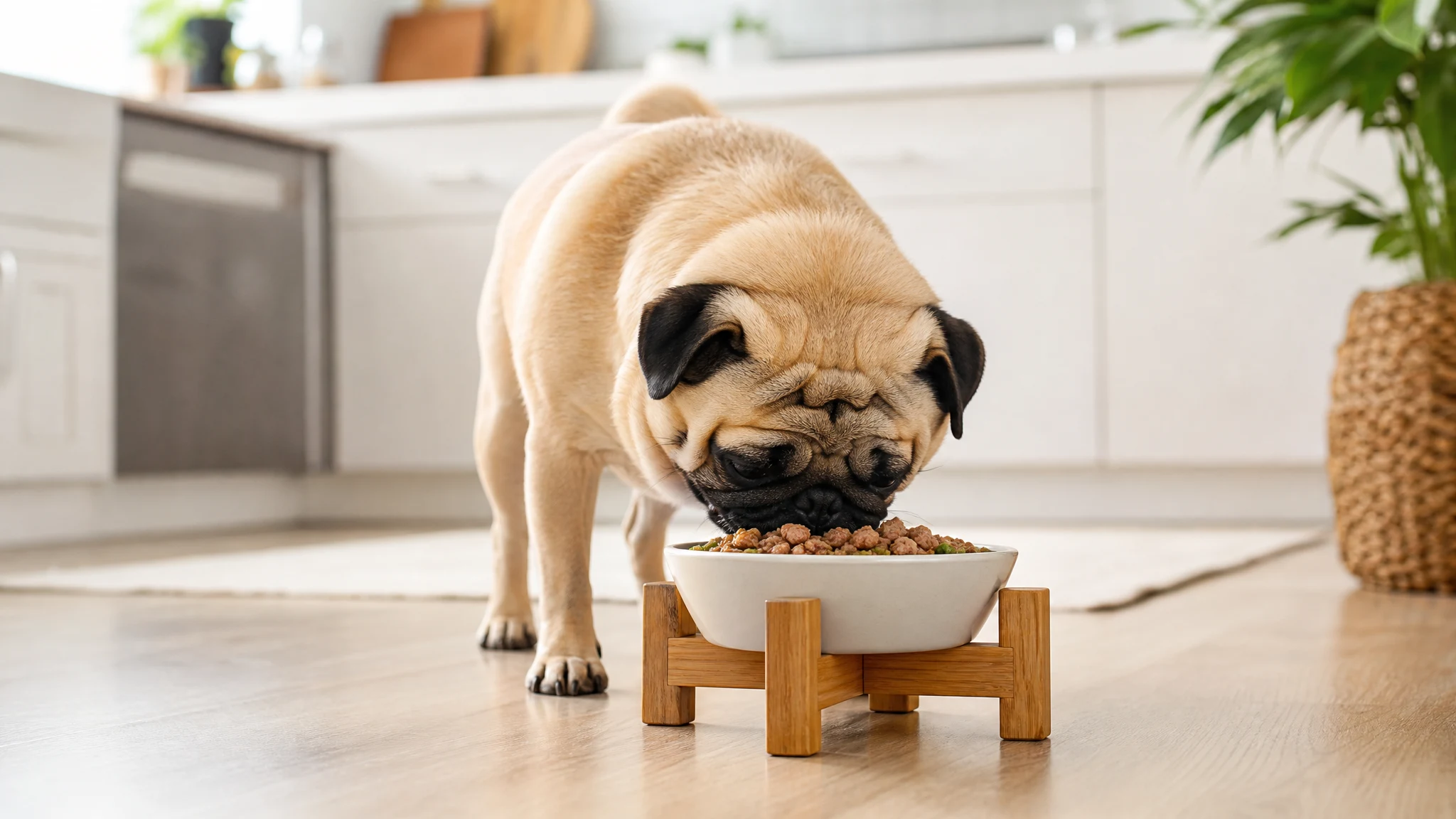
General nutrition information compiled from product labels and published sources, not veterinary advice. Your veterinarian is the right person to choose a diet for your dog, especially one with a health condition.
Moving a young dog from puppy to adult food sounds simple. For a Pug, it deserves a little more thought. The breed is small, and Orvis lists obesity among the common Pug health issues. A food that suits a growing puppy can be too rich once growth slows.
This guide covers when to switch, what to compare on the labels, and how to make the change gradually. It is based on label data and published breed information, not on feeding trials or taste tests of our own.
When to Switch: Look at Age, Weight and Your Vet
There is no single date that fits every Pug. Orvis gives the average adult Pug weight as 14 to 18 pounds. We could not find a published age at which Pugs count as adults, so treat any age you read as a rough guide.
The brand's own labeling is a useful anchor. Royal Canin's US site lists its Pug Puppy formula for purebred Pugs from 8 weeks to 10 months. It lists its Pug Adult formula for purebred Pugs 10 months and older. That is one manufacturer's cutoff for its own products. It is not a rule for every food or every dog.
Ask your veterinarian to confirm the timing at a checkup. They can look at your puppy's body condition, growth and health history. That matters most for a dog with a health condition.
Materials You Will Need
- Your current puppy food, enough to last the whole transition
- The new adult food, in a small bag at first
- A standard dry measuring cup, or a kitchen scale if you prefer grams
- A notebook or phone note for daily portions and stool quality
- The feeding guide printed on each bag or on the brand's product page
- A scale for weighing your dog, which can be your home scale (weigh yourself with and without the dog)
Step 1: Read Both Labels Side by Side
Start with the AAFCO statement on each bag. It tells you which life stage the food is formulated for. A food made for growth is not the same as one made for adult maintenance.
Some foods are labeled for all life stages. Those can be used for puppies and adults, but the calories per cup still differ, and calories matter for a Pug.
Here is how a few label figures compare. These come from the brands' own product pages.
| Food | Life stage | Calories per cup |
|---|---|---|
| Royal Canin Pug Puppy | Growth | 369 kcal ME (as fed, calculated) |
| Royal Canin Pug Adult | Maintenance | 315 kcal ME (as fed, calculated) |
| Hill's Science Diet Puppy Small & Mini Chicken & Brown Rice | Growth | 418 kcal |
| Hill's Science Diet Adult Perfect Weight Small & Mini Chicken & Brown Rice | Maintenance (weight management) | 298 kcal |
Within the Royal Canin Pug line, the adult food has about 54 fewer calories per cup than the puppy food. The Hill's pair is a different matter. One is a standard puppy recipe and the other is a weight-management recipe, so the gap is wider than a regular puppy-to-adult step would be.
Do not read a gap like that as a verdict on either food. It shows why you should never pour the same cup of a new food and assume it delivers the same energy.
Also compare ingredients. The Royal Canin Pug Puppy lists chicken by-product meal, brewers rice, corn, chicken fat and wheat gluten first. The adult version leads with brewers rice, brown rice, oat groats, chicken by-product meal and corn. If your Pug has a known food sensitivity, check these lists with your vet. Marketing words on the front of the bag tell you less than the ingredient panel does.
Step 2: Pick the Adult Food and Check Its Feeding Guide
Choose an adult food your veterinarian is comfortable with for your individual dog. Then read its feeding guide as a starting point, not a prescription.
Feeding guides are organized differently. Royal Canin's Pug Adult page lists amounts for 13 to 22 pound dogs by low, medium and high activity. For example, a 13 pound, low-activity dog is listed at 1 1/8 cups (92 g) per day. VICTOR's Hi-Pro Plus Small Breed Adult page uses an 8 ounce measuring cup. It lists 1 cup daily for a 10 pound dog and says to adjust to keep good body condition after age one.
Hill's pages for the small-breed foods above simply say to adjust amounts to maintain optimal weight, and to ask your veterinarian if you are unsure. For a Pug, that advice is worth following literally. For a broader look at amounts by age and weight, see our Pug feeding chart by age and weight.
Step 3: Weigh Your Pug and Write Down a Baseline
Before you change anything, record your puppy's weight, the daily amount of puppy food, and how many meals you feed. Note stool quality and energy too. These notes let you tell later whether a change in your dog is the food or something else.
Run your hands along the ribs. You should be able to feel them under a thin layer of padding. If you can't, mention it to your vet before the switch.
Step 4: Mix the Foods Gradually
A gradual change is the usual approach, because abrupt changes can upset a dog's stomach. Many owners spread the change over about a week to ten days. Your vet may suggest a slower pace for a sensitive dog.
- Days 1 to 3: about one quarter new food and three quarters puppy food.
- Days 4 to 6: about half and half.
- Days 7 to 9: about three quarters new food and one quarter puppy food.
- Day 10 onward: all adult food, if stools and appetite have stayed normal.
If you see loose stools or your dog refuses meals, go back to the last mix that worked. Hold there for a couple of days before moving on. Call your vet if it continues, or if your dog vomits or seems unwell.
Step 5: Measure the Total, Not Just the Cups
Because the two foods have different calories per cup, base the total daily amount on the new food's feeding guide, not on how much puppy food the dog was eating. Split it into the same number of meals your puppy is used to. Many owners of adult dogs settle on two meals a day, but ask your vet what suits your Pug.
Count treats and chews in the day's total. In a 14 to 18 pound dog, a few extra handfuls of kibble add up.
Step 6: Monitor for Four to Six Weeks
Weigh your Pug every week or two and check body condition by feel. If weight creeps up, trim the daily amount slightly and recheck. If your dog gets thin, increase it a little. Either way, make small changes and let your vet confirm.
Weight is worth watching for more than looks. A Texas A&M College of Veterinary Medicine press release from June 16, 2026 describes an ongoing clinical trial in short-muzzled dogs, including a Pug. Dogs that reached an ideal weight showed improvements in breathing. The trial is still under way, so this is early information and not a promise for any one dog. It does suggest that keeping a Pug lean is a reasonable goal to discuss with your vet.
Tips for a Smoother Switch
- Keep the same feeding times and bowl. Changing the food is enough change at once.
- Buy a small bag of the new food first, in case your dog does not like it.
- Check kibble size. Brand pages for several foods here do not state kibble dimensions, so contact the brand if size matters for your dog's short muzzle. Royal Canin describes its Pug kibble as shaped for the breed's short, square muzzle.
- Keep fresh water out. A change in food can change how much a dog drinks.
- Do not start the switch during travel, boarding or other stressful events.
Common Mistakes to Avoid
- Switching all at once. A sudden change is a common cause of stomach upset.
- Copying the puppy cup size. The new food may be less calorie-dense, or in some cases more, so recalculate from its label.
- Switching too early. Puppy food is made for growth. Moving too soon may mean your dog is not getting what the growth-stage label is designed to provide. Confirm timing with your vet.
- Staying on puppy food too long. Growth formulas tend to be richer, which can be a problem for a breed prone to obesity.
- Adding supplements to fix the change. Do not add supplements unless your veterinarian recommends them and gives you the amount.
- Treating a food as a cure. No dog food treats or prevents hip dysplasia, allergies or heart disease. Your vet decides what is right for an individual dog, and prescription diets come only from a veterinarian.
What to Expect
Most healthy dogs handle a gradual transition with little fuss. You may notice slightly different stool for a few days. Appetite, energy and coat should stay steady. Over the following weeks, a well-matched portion may help your Pug hold a steady weight, though results vary from dog to dog.
If your Pug has a health condition, check amounts and food choice with your veterinarian before you start. If you are weighing a fresh or wet food, remember that those pages list calories per can or pack, not per cup, so the cup-for-cup swap does not work.
Sources
- Orvis Pug breed page
- Texas A&M College of Veterinary Medicine press release, June 16, 2026
- Royal Canin US: Pug Puppy Dry Dog Food
- Royal Canin US: Pug Adult Dry Dog Food
- Hill's Pet: Science Diet Puppy Small & Mini
- Hill's Pet: Science Diet Adult Perfect Weight Small & Mini
- VICTOR: Hi-Pro Plus Small Breed Adult