Tracking a Pug Puppy's Weight: A Month-by-Month Guide
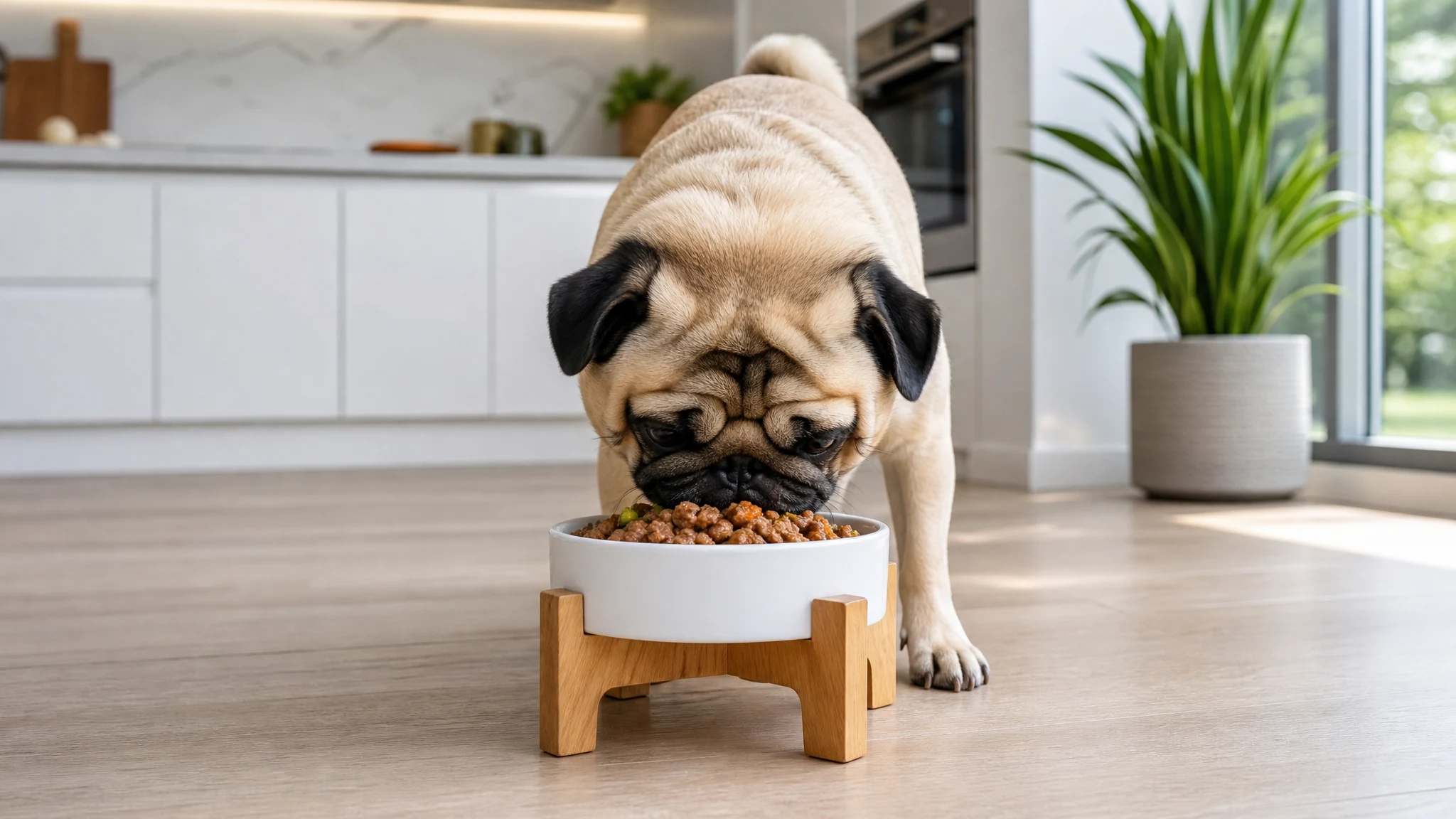
General nutrition information compiled from product labels and published sources, not veterinary advice. Your veterinarian is the right person to choose a diet for your dog, especially one with a health condition.
A Pug puppy grows fast, and a Pug that gains too much weight can struggle later. That is why a simple weight log is one of the most useful tools you can keep. This guide shows you how to build your own pug puppy weight chart, step by step, and how to use it when you adjust meals.
You will not find a table of "correct" weights by month here. The sources we relied on do not publish one for Pugs, and a made-up number would be worse than none. Instead, you will learn how to track your own puppy's curve and read it with your veterinarian.
What a Pug Puppy Is Growing Toward
The Orvis Pug breed page lists the average adult weight as 14 to 18 pounds. It also lists a life expectancy of 13 to 15 years. Treat both as typical ranges, not targets for your individual dog. The Orvis page is a secondary source, so ask your breeder or veterinarian what size range suits your puppy's parents and frame.
Orvis also lists obesity among the common Pug health issues. A Texas A&M College of Veterinary Medicine press release from June 16, 2026, describes an ongoing clinical trial in short-muzzled dogs, including a Pug. It reports that dogs reaching an ideal weight showed improvements in breathing. The trial is still running, so treat this as an early signal. It does not show that weight loss fixes breathing problems. It does show why watching weight from puppyhood is worth the effort.
Materials You Need
- A scale. A baby scale or small digital kitchen scale works for a young puppy. Later, a bathroom scale works: weigh yourself, then weigh yourself holding the puppy, and subtract.
- A notebook or spreadsheet. You need columns for date, weight, daily food amount and notes.
- A measuring cup or gram scale. Measuring food by weight is more consistent than scooping.
- Your puppy food's label or brand page. You will need its feeding guide and calorie statement.
- Your veterinarian's contact details. Visit weights are a useful cross-check for your home scale.
- A few tiny treats. They help your puppy stay calm and still on the scale.
Step-by-Step: Build Your Pug Puppy Weight Chart
Step 1: Record the starting weight
Weigh your puppy the day they come home. Write down the date, the weight and the time of day. Ask the breeder or shelter for any earlier weights, and enter those too. They give your chart a head start.
Step 2: Weigh at the same time, under the same conditions
Weigh before a meal, after a potty break, on the same scale each time. A full belly or a full bladder can shift the number. Consistency matters more than the exact time you choose.
Step 3: Choose a weighing rhythm
A reasonable routine is weekly while your puppy is very young and growing quickly. Many owners then move to every two weeks, and later monthly, as growth slows. Ask your veterinarian which rhythm fits your puppy. Do not skip weeks in the early months, because that is when changes are easiest to catch.
Step 4: Set up a month-by-month log
Make one row for each month of age, with space for several weigh-ins inside it. Here is a simple layout to copy:
| Age | Weigh-ins | What to note |
|---|---|---|
| 2 to 3 months | Weekly | Weight, meals per day, stool quality, energy |
| 4 to 6 months | Weekly or every two weeks | Weight, food amount, treats given, body shape |
| 7 to 10 months | Every two weeks | Weight, whether gain is slowing, waist visible from above |
| 10 months and older | Monthly | Weight, transition to adult food, body condition |
The ages above are a logging plan, not a growth standard. Royal Canin's Pug puppy page describes its puppy formula for purebred Pugs from 8 weeks to 10 months, and its adult formula for 10 months and older. That is one brand's life-stage split. Your veterinarian decides when your own puppy should switch foods.
Step 5: Log what your puppy eats
Weight only makes sense next to food. Each time you weigh, note the daily food amount, the number of meals and any treats or chews. Treats count toward daily calories, so write them down.
Step 6: Compare the feeding guide to your puppy
Use the label's feeding guide as a starting point, then adjust to your puppy's body. For example, the Royal Canin Pug Puppy product page gives a table by puppy age and expected adult weight (13, 18 or 22 pounds). It lists a 2-month-old puppy with a 13 pound target adult weight at 1 1/8 cups (105 grams) per day. The same page lists 369 kcal per cup. Other brands, such as Hill's Science Diet and VICTOR, publish their own guides, and they differ. They tell you to adjust amounts to keep your dog in good condition.
For a deeper look at portions across ages, see our Pug feeding chart by age and weight.
Step 7: Check body shape, not just the number
Once a week, look and feel. From above, you should see a slight waist behind the ribs. From the side, the belly should tuck up a little. You should be able to feel the ribs under a thin layer of padding without pressing hard. Pugs have loose skin and a stocky build, so the scale alone can mislead. Your veterinarian can show you how to score body condition.
Step 8: Plot the trend
After a few weeks, draw a simple line graph with age on one axis and weight on the other. A steady upward line is what most owners hope to see in a growing puppy. Sudden jumps, plateaus or drops are worth a call to your veterinarian. That plotted line is your pug puppy weight chart, and it tells you far more than a single weigh-in.
Step 9: Adjust slowly
If your puppy seems to be gaining faster than their frame suggests, do not cut meals sharply on your own. First check your measuring, the treat count and the label amount. Then talk with your veterinarian before changing the plan. Growing puppies need complete and balanced nutrition, so trimming food without guidance can backfire.
Tips for Better Tracking
- Take a photo from above and from the side each month. Photos show changes the scale cannot.
- Weigh at your vet's office now and then and compare it with your home scale. A small difference between scales is normal, so keep using one scale at home.
- Use the same measuring cup every time. Cups vary in size, and Royal Canin's own page notes calories per cup, so cup size matters.
- Write down any food change, including a new brand, with the date. If weight or stool shifts, you will know why.
- Ask family members to log treats too. Several people feeding "just a little" is a common reason for extra calories.
Common Mistakes to Avoid
- Chasing a single number. A weight that looks right on paper can still be too heavy or too light for your puppy's frame.
- Free feeding. Leaving food out makes it hard to know what your puppy eats and makes the log less useful.
- Trusting the bag's amount without adjusting. A feeding guide is a starting point. It cannot know your puppy's activity or metabolism.
- Switching foods too early. Check with your veterinarian before moving from puppy to adult food. Do it gradually.
- Adding supplements to speed growth. A complete and balanced diet already covers the basics, and extras should only come from your veterinarian.
- Comparing with other dogs. Another Pug's weight is not your puppy's goal.
Expected Results
With regular weigh-ins and honest food logging, you may notice patterns earlier, such as a flattening curve or a sudden jump after a diet change. Many owners find that a written log makes vet visits easier, because you can show real numbers. It can support healthier weight management, but it does not guarantee a particular outcome. Each puppy grows differently.
A log will not tell you why a weight changed. Only your veterinarian can look at your puppy and decide whether a change matters.
When to Call Your Veterinarian
- Your puppy loses weight or stops gaining for several weigh-ins in a row.
- Weight rises quickly between visits.
- You see noisy breathing, tiring easily or reluctance to eat. Pugs have short muzzles, and the Orvis page lists an elongated palate among their health concerns.
- Your puppy has any health condition. Confirm all feeding amounts with your vet before changing them.
The Orvis page also lists hip dysplasia, Legg-Perthes disease, patellar luxation and Pug Dog Encephalitis as Pug health concerns. Food does not manage most of these according to that source, so a diet change should not be your answer to them. Your veterinarian decides what a particular dog needs.
How We Approach Food Comparisons
When this site mentions foods, we compared label data published by the brands, such as the nutrition statement, ingredient list and calories. We did not run feeding trials or taste tests. A label tells you what is in the bag, not how your puppy will respond.