Is Your Pug Overweight? A Body Condition and Diet Guide
General nutrition information compiled from product labels and published sources, not veterinary advice. Your veterinarian is the right person to choose a diet for your dog, especially one with a health condition.
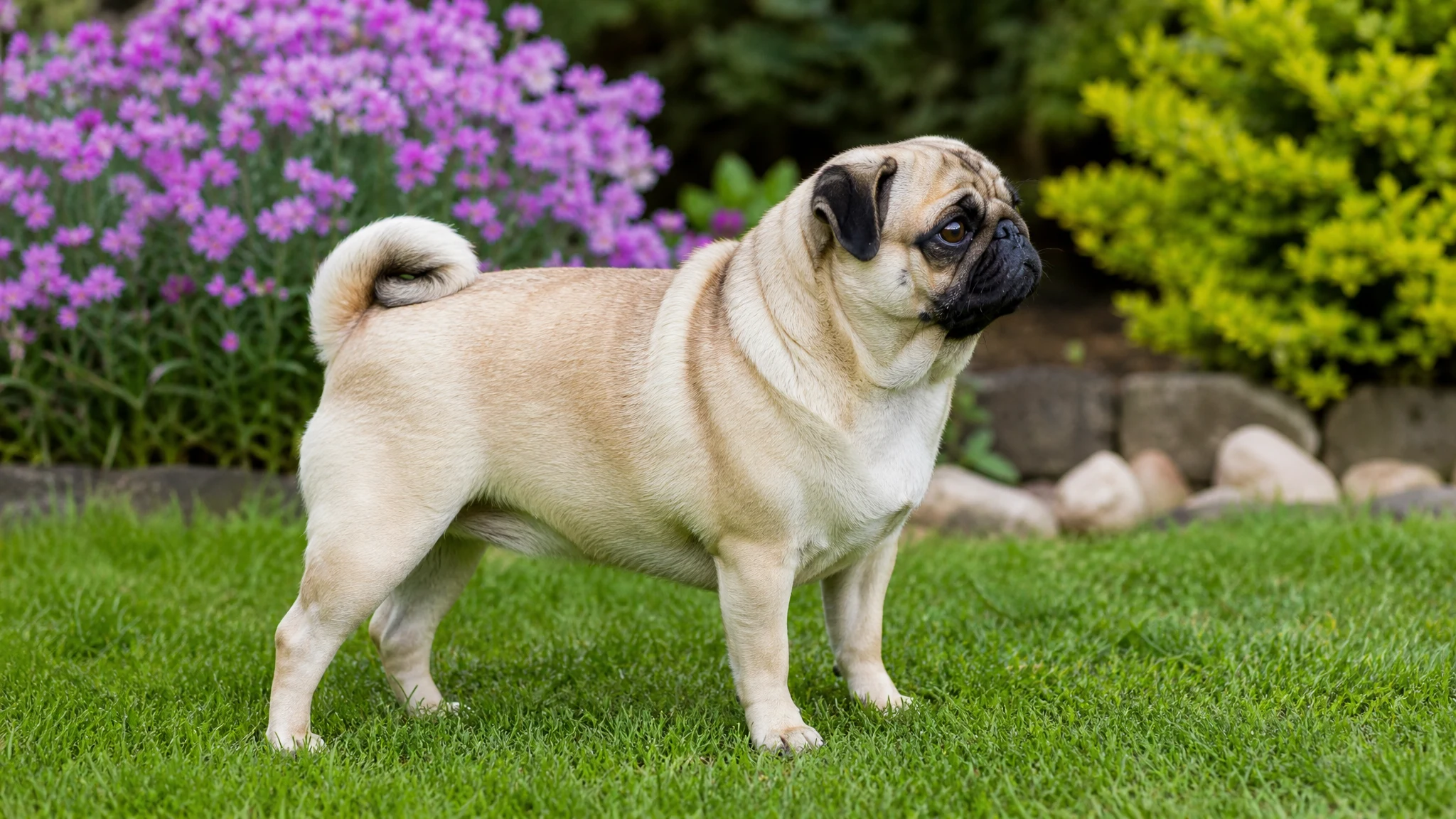
A Pug overweight by even a pound or two is easy to miss. The breed is compact and sturdy, and a round body can look normal. This guide shows you how to check your dog's body condition at home, read a dog food label with a skeptical eye, and plan a cautious change with your veterinarian.
Nothing here replaces a vet exam. A veterinarian decides what is right for an individual dog, especially one with breathing, joint or other health concerns.
Why weight matters for this breed
The Orvis Pug breed page lists obesity among the common Pug health issues. It also lists an elongated palate, a brachycephalic (short-muzzled) airway concern, and hip dysplasia. Orvis gives an average adult weight of 14 to 18 pounds and a life expectancy of 13 to 15 years. These are typical ranges from a secondary source, so your own dog's healthy weight may differ.
Texas A&M College of Veterinary Medicine announced a clinical trial in short-muzzled dogs, including a Pug, in a June 16, 2026 press release. It says dogs that reached an ideal weight showed improvements, and that the trial is ongoing. That is early information. It does not show that weight loss fixes breathing problems, and it is one more reason to ask your vet about your dog's weight.
For a wider look at what shapes a Pug's diet, see our overview of Pug nutrition and the diet factors that matter for this breed.
What you need
- A kitchen scale that weighs in grams or ounces, for food
- A bathroom scale, or a pet scale at your vet's office, for your dog
- A soft cloth tape measure
- A level, standard measuring cup
- The bag or can of your dog's current food
- A notebook or phone notes to record weights, portions and treats
- A well-lit spot and a few minutes of calm time with your dog
Step-by-step: check body condition and plan a diet change
Step 1: Weigh your dog
Weigh yourself holding your Pug, then weigh yourself alone, and subtract. Write the number down with the date. A single weight tells you little. A trend over several weeks tells you much more.
Compare the number to the 14 to 18 pound average from Orvis, but do not treat it as a target. A small-framed Pug and a larger-framed Pug can both be healthy at different weights.
Step 2: Look from above
Stand over your dog while they stand squarely. In a healthy shape you should see a waist, a slight narrowing behind the ribs. If the body looks like a straight tube or bulges outward at the middle, extra fat is a possibility.
Pug coats and loose skin can hide this, so do not rely on the look alone.
Step 3: Look from the side
Check the belly line, where the chest meets the abdomen. A healthy dog's belly generally tucks up toward the back legs. A belly that hangs level with the chest or sags is worth mentioning to your vet.
Step 4: Feel the ribs
Place your palms flat on both sides of the chest and press lightly. You should be able to feel the ribs under a thin layer of padding, like the back of your hand. If you must press hard to find them, that suggests extra covering.
Also feel along the spine and at the base of the tail. Thick, soft padding there is another sign to raise with your vet.
Step 5: Measure and note the neck and waist
Measure around the chest behind the front legs, and around the waist just in front of the hind legs. Write both down. These numbers do not diagnose anything, but changes over time can show whether your dog is slimming down or filling out, even when the scale barely moves.
Step 6: Ask your vet to confirm
Bring your notes to a visit. Your veterinarian can score body condition, check for breathing or joint concerns, and set a target weight. Ask whether any food change is wise for your dog. If a prescription weight diet is appropriate, only a veterinarian can prescribe it.
Step 7: Audit what your dog eats now
For a week, record everything: meals, treats, chews, table scraps, and food used for medicine. Weigh the meals on the kitchen scale instead of scooping, since a scoop can vary a lot from one pour to the next.
Many people are surprised by how much comes from small extras. Handing out treats is one of the easiest things to trim.
Step 8: Read the label like a skeptic
On the label, look for three things.
- The AAFCO statement. It should say the food is complete and balanced for your dog's life stage.
- Calories per cup or per can. This matters more for weight than the front-of-bag claims.
- The guaranteed analysis. Check whether values are minimums or dry matter averages, because the two are not directly comparable.
Words like "premium" or "natural" tell you little about calories. No food prevents or treats obesity on its own. Portions and calories drive weight, and your vet guides the plan.
Step 9: Compare a few foods by label data
We compared published label data from the brands' own pages. We did not run feeding trials or taste tests, so this is a reading exercise, not a recommendation. The figures below are what each brand lists.
| Food | Calories listed | Protein and fiber listed |
|---|---|---|
| Royal Canin Pug Adult Dry (Breed Health Nutrition) | 315 kcal ME per cup | Protein 23.0% min, fat 14.0% min, fiber 3.4% max |
| Hill's Science Diet Adult Perfect Weight Small & Mini Chicken & Brown Rice | 298 kcal per cup | Dry matter averages: protein 28.8%, fat 11.2%, fiber 10.3% |
| VICTOR Hi-Pro Plus Small Breed Adult | 360 kcal per cup | Protein 30.0% min, fat 14.0% min, fiber 5.0% max |
The Hill's figures are dry matter averages, while the other two are as-fed minimums and maximums, so do not compare those columns directly. Calories per cup do differ. A cup of one food can carry noticeably more energy than a cup of another, which is why switching foods by volume alone can quietly change your dog's intake.
Royal Canin lists its Pug Adult formula for purebred Pugs 10 months and older and describes a custom kibble shape for the Pug's muzzle, with no dimensions stated. You can see the details on the Royal Canin Pug Adult page. The Hill's weight-management recipe is on Hill's own product page, and the VICTOR food is on VICTOR's product page. Note that VICTOR's food is labeled for all life stages, which is a different positioning from an adult weight-management food.
Step 10: Set portions as a starting point
Feeding charts are starting points. For example, Royal Canin's Pug Adult table lists 1 1/8 cups (92 g) per day for a 13 pound, low-activity dog. Hill's pages say to adjust amounts as needed to maintain optimal weight and to ask your veterinarian if unsure. VICTOR says to adjust to maintain good body condition.
Ask your vet how many calories per day suit your dog, then convert that to grams using the calories listed on the label. Divide the total into measured meals. Do not cut food sharply on your own.
Step 11: Change foods slowly
If your vet suggests a new food, mix it with the old one over about a week or so, increasing the new share gradually. Watch stools and appetite. Stop and call your vet if anything seems off.
Step 12: Recheck every few weeks
Weigh, feel the ribs and look from above on the same day each week or two. Write it all down. If nothing changes after several weeks, tell your vet instead of cutting more food yourself.
Tips
- Count treats toward the daily total, and use a few pieces of the dog's regular kibble as rewards.
- Use short, gentle walks and play as your vet allows. Pugs can struggle in heat and with exertion because of their short muzzles, so ask your vet what is safe.
- Keep everyone in the household on the same plan, so a dog is not fed twice.
- Use a harness instead of a collar for walks, which is often more comfortable for a short-muzzled dog.
Common mistakes to avoid
- Guessing portions with a scoop. Scoops vary. Weigh the food.
- Switching to a "light" food and feeding the same cup. The label calories still decide the result.
- Adding supplements to fix weight. Ask your vet before giving anything extra.
- Crash dieting. Rapid cuts can leave a dog hungry and short of nutrients.
- Relying on looks alone. Skin folds and coat can hide changes, so use your hands and a scale too.
- Feeding a puppy food to an adult. Puppy foods are often more calorie dense. The Hill's puppy recipe on the list, for example, shows 418 kcal per cup.
What results to expect
Many owners who measure meals, trim extras and recheck regularly see steady, gradual changes in body shape and weight over weeks to months. Results vary by dog, age, activity and health, and no outcome is certain.
Some dogs may breathe more comfortably or move more easily as they approach a healthy weight, as the early Texas A&M trial suggests, but that research is still ongoing. Joint and airway problems have many causes, and your vet is the one to judge whether weight plays a part for your dog.
If your dog is a senior, has health conditions or is a puppy, ask your vet before changing calories. Growth and age change what a dog needs.