Pug Diet Myths: What the Evidence Actually Supports
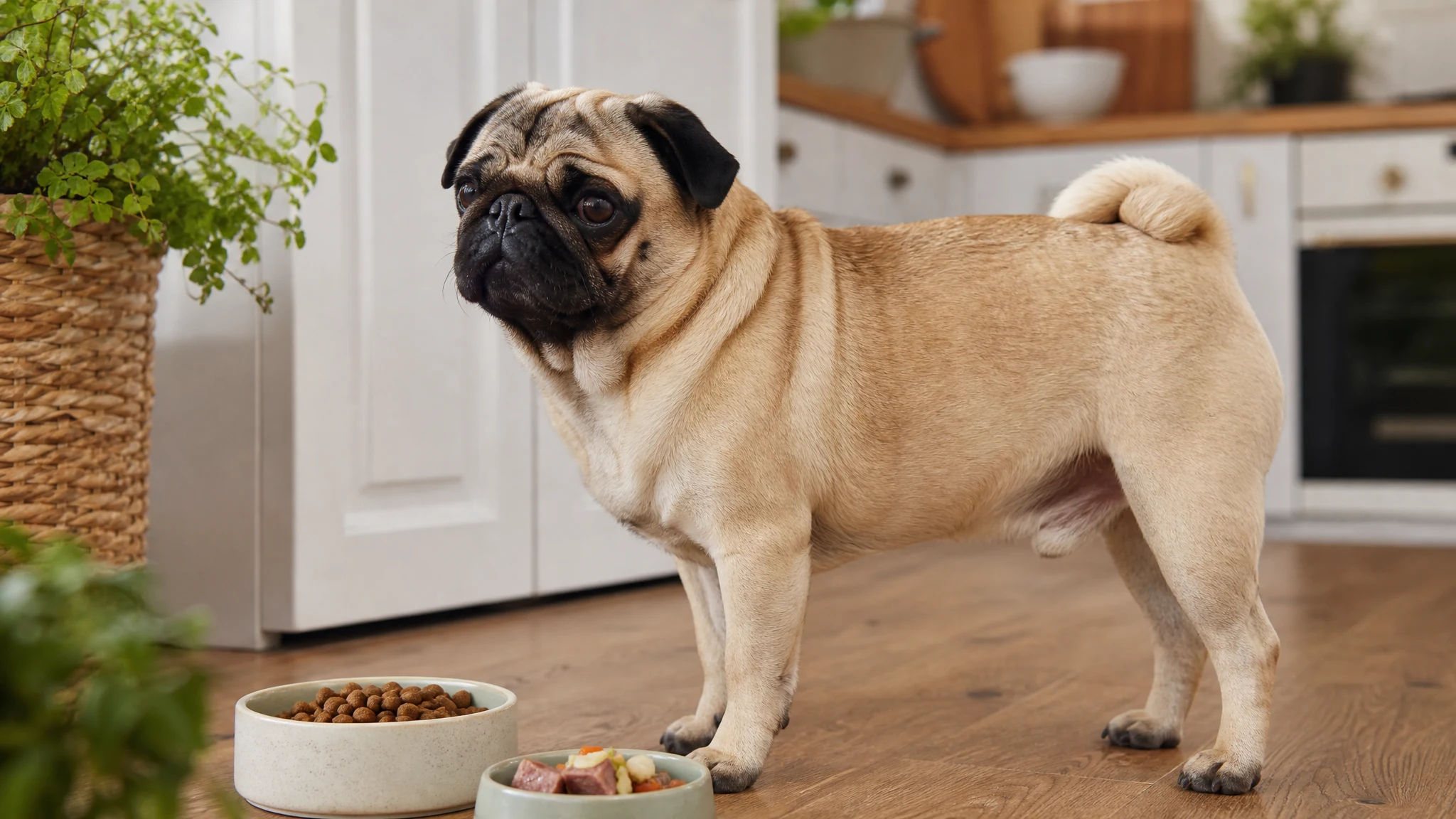
General nutrition information compiled from product labels and published sources, not veterinary advice. Your veterinarian is the right person to choose a diet for your dog, especially one with a health condition.
Pug owners hear a lot of confident advice about food. Some of it is useful. Some of it is marketing that has been repeated until it sounds like fact.
This guide shows you how to test a claim against a label and a published source before it changes your Pug's bowl. A sound pug diet starts with reading, not with trends. For the wider picture of what matters for this breed, see our overview of the diet factors that matter for Pugs.
One note on method. We compared label data published by the brands and information from named sources. We did not run feeding trials or taste tests, and we are not telling you which food to buy.
What you need before you start
- The bag or can your Pug eats now, with the full label visible.
- A kitchen scale that reads in grams, or a standard measuring cup.
- A list of every treat, chew and table scrap your Pug gets in a normal week.
- Your Pug's recent weight, ideally from the last veterinary visit.
- A notebook or phone note for what you find.
- Your veterinarian's contact details, since they decide what suits your individual dog.
How to test a Pug diet claim, step by step
Step 1: Write down the claim in one sentence
Vague claims are hard to check. "Pugs need special food" is vague. "Pugs need a food made for their breed" is something you can look at. Write the claim down plainly before you judge it.
Step 2: Find the AAFCO statement on the label
Look for the sentence saying the food is formulated to meet the AAFCO Dog Food Nutrient Profiles, or that feeding tests substantiate it. It names a life stage: growth, maintenance, or all life stages. This is the most useful line on the bag, and it matters more than the front-panel photos.
Brands word it differently. The Royal Canin Pug Adult page says it is formulated for maintenance. The Hill's Science Diet pages say AAFCO feeding tests substantiate their foods. VICTOR's Hi-Pro Plus small breed formulas are listed for all life stages, except growth of large size dogs. These are different ways of reaching a complete diet, and the label tells you which one applies.
Step 3: Check the claim against the myths below
Work through each myth with the label in your hand.
Myth: A Pug needs a Pug-specific food
Royal Canin makes Pug formulas. Its US product pages describe a Pug Puppy food for purebred Pugs from 8 weeks to 10 months and a Pug Adult food for dogs 10 months and older. The brand says the kibble is shaped for the Pug's short, square muzzle. The pages give no kibble dimensions, so check with the brand if size matters to you.
A breed-specific shape may suit some dogs. The evidence we found does not show that a Pug can only thrive on a breed-named food. What the label supports is a complete and balanced diet for the right life stage, at a portion that keeps the dog lean.
Myth: Grain-free is the healthier choice
Grain-free is a description of ingredients, not a health grade. The FDA has an investigation page on a possible link between certain diets and canine dilated cardiomyopathy (DCM). Its latest update is dated December 23, 2022, and the FDA says it will not release further public updates until there is meaningful new scientific information. That is a reason to be careful with absolute claims in either direction.
Among the foods we reviewed, most are not grain-free. Freshpet's Small Dog Bite Size Chicken Recipe is listed as grain-free. If you are weighing grain-free against grain-inclusive food, ask your veterinarian rather than picking by trend.
Myth: A little extra weight is normal for a Pug
Orvis, in its Pug breed page, lists obesity among the breed's common health issues. Pugs typically weigh 14 to 18 pounds according to the same page, so even a pound or two is a large share of body weight.
Texas A&M's College of Veterinary Medicine announced a clinical trial in short-muzzled dogs, including a Pug, in a press release dated June 16, 2026. Dogs reaching ideal weight showed improvements, and the trial was still ongoing at the time. That is early information. It does not show that weight loss will fix breathing problems in any one dog, but it is a good reason to take body condition seriously and to talk to your veterinarian.
Myth: Feed the amount on the bag and you are done
Feeding tables are starting points. For example, the Royal Canin Pug Adult page lists 1 1/8 cups (92 g) a day for a 13 lb dog with low activity. The Hill's pages tell owners to adjust amounts to maintain optimal weight and to ask a veterinarian if unsure. VICTOR's adult page says to adjust to keep good body condition.
Calories per cup differ a lot between foods. The Royal Canin Pug Adult food lists 315 kcal per cup, Hill's Adult Perfect Weight Small & Mini lists 298, and Hill's Adult 11+ Small & Mini lists 378. Switching brands cup for cup can quietly change daily calories.
Myth: Fresh food is automatically better
Fresh and kibble labels are hard to compare. Freshpet lists a 16% minimum protein and 12% minimum fat, with 267 kcal per cup. A dry food lists much higher percentages partly because it holds far less water. Comparing those numbers directly is misleading.
The same trap appears between brands. Hill's pages give average nutrients on a dry matter basis, while Royal Canin and VICTOR give guaranteed minimums as fed. Those figures are not interchangeable. JustFoodForDogs lists its Pantry Fresh Chicken & Rice by the pack (387.5 kcal per 12.5 oz pack) and publishes no per-cup figure, so check the brand's calculator or ask your veterinarian before swapping.
Myth: A food can prevent your Pug's inherited problems
Orvis lists hip dysplasia, an elongated palate, Legg-Perthes disease, patellar luxation and Pug Dog Encephalitis as Pug health concerns. For the last three, the source does not tie them to diet, so no food claim is supported. Be wary of any label or ad that implies a food prevents, treats or cures a condition. Prescription diets are something only a veterinarian prescribes.
Myth: Pugs need a large-breed puppy formula
The large-breed growth guidance applies to dogs that reach 70 lb or more as adults. A Pug at 14 to 18 lb is far from that. You may see "except for growth of large size dogs" on small-breed labels, such as VICTOR's. That wording is expected for a small dog and is not a flaw.
Step 4: Compare labels on the same basis
Put two labels side by side and compare only matching items: the AAFCO statement, the first five ingredients, calories per cup (or per can), and whether protein and fat are shown as fed or dry matter. Write the gaps down too. If a page does not state kibble size, note "unknown" instead of guessing.
Step 5: Weigh and measure
Weigh your Pug's daily portion in grams if you can. Scoops vary widely from one cup to the next. Count treats as food. A short list of what goes in the bowl each day is often more revealing than any label.
Step 6: Bring your notes to your veterinarian
Share the claim, the label details and the weight record. Ask whether the food, the portion and the target weight make sense for your dog's age, activity and health. Make food changes gradually and only with their guidance.
Tips
- Check the life stage first. A puppy food and a senior food are built for different needs.
- Save a photo of each label you compare. Brands change formulas.
- Keep a weight record every few weeks. Small changes show up sooner there than by eye.
- Read the whole product page, not just the headline. Brands sometimes contradict themselves. VICTOR's puppy page, for one, states a different protein figure in its body text than in its table.
Common mistakes to avoid
- Comparing as-fed and dry matter numbers as if they matched.
- Switching foods suddenly because of an ad or a forum post.
- Using a food's "small breed" tag as proof that it suits your Pug.
- Adding supplements on top of a complete diet without asking your veterinarian.
- Treating a feeding table as a fixed rule instead of a starting point.
What results to expect
Done carefully, this process may help you spot claims the evidence does not support and notice portions that drift upward. Some owners find it easier to keep a steady weight when they measure meals and count treats. Results vary by dog, and no label guarantees an outcome.
Orvis gives a typical Pug life expectancy of 13 to 15 years. Over that span, a steady routine of measured meals and regular weigh-ins is one practical part of care. It does not replace veterinary guidance.
Sources
- Orvis Pug breed page
- Texas A&M College of Veterinary Medicine press release, June 16, 2026
- FDA CVM: Investigation into Potential Link between Certain Diets and Canine Dilated Cardiomyopathy
- Royal Canin Pug Adult Dry Dog Food
- Royal Canin Pug Puppy Dry Dog Food
- Hill's Science Diet Adult Perfect Weight Small & Mini
- Hill's Science Diet Adult 11+ Small & Mini
- VICTOR Hi-Pro Plus Small Breed Adult
- VICTOR Hi-Pro Plus Small & Medium Breed Puppy
- Freshpet Small Dog Bite Size Chicken Recipe
- JustFoodForDogs Pantry Fresh Chicken & Rice Recipe