What Should Be in a Pug's Daily Diet? A Label-Reading Guide
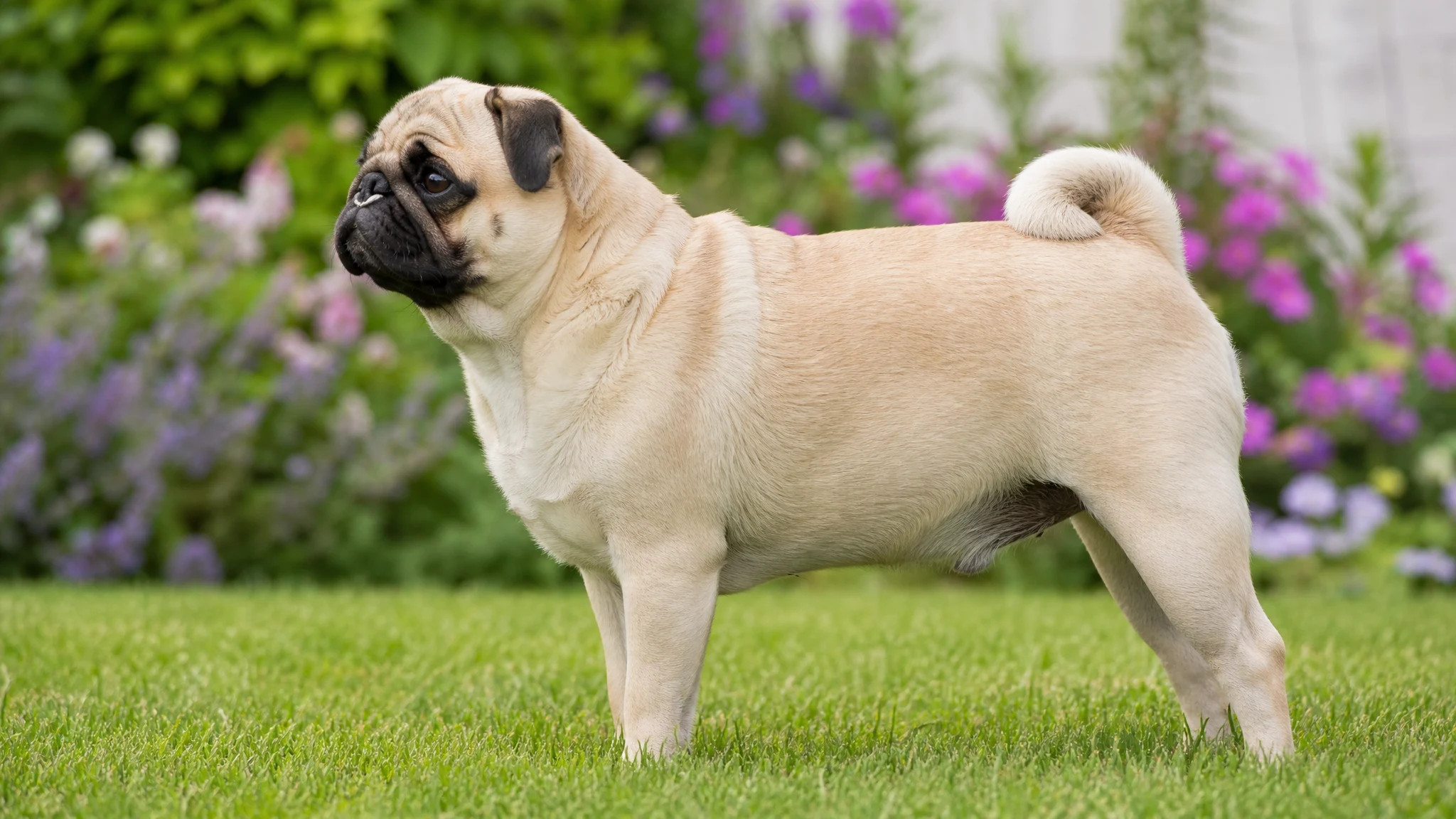
General nutrition information compiled from product labels and published sources, not veterinary advice. Your veterinarian is the right person to choose a diet for your dog, especially one with a health condition.
A good pug diet starts with the label, not the front of the bag. Pugs are small, compact dogs, and the Orvis Pug breed page lists obesity among their common health issues. So the numbers on the back of the package matter more than the photo on the front.
This guide walks you through reading a dog food label step by step. It uses real label data from a few brands as examples. It is not a ranking. We compared published label data only. We did not run feeding trials or taste tests, and we are not telling you which food to buy.
What You Need Before You Start
- The bag, can or tray of the food you are considering, or its brand product page.
- Your Pug's current weight from a recent vet visit or a home scale. The Orvis Pug breed page gives an average of 14 to 18 pounds, but individual dogs vary.
- A level measuring cup, or a kitchen scale that reads in grams.
- A notebook or phone note for calories and portions.
- Your veterinarian's number, for the questions a label cannot answer.
Step 1: Find the Nutritional Adequacy (AAFCO) Statement
Look for a sentence that says the food is formulated to meet, or has been shown in feeding tests to meet, the AAFCO Dog Food Nutrient Profiles. It should name a life stage: growth, maintenance, or all life stages.
The wording differs between brands, and the difference is real. The Royal Canin Pug Adult label says the food is formulated to meet AAFCO levels for maintenance. The Hill's Science Diet Adult Perfect Weight Small & Mini page says AAFCO-procedure feeding tests substantiate the food for adult maintenance. Both are complete-diet claims, made by different routes.
Match the statement to your dog. A puppy needs a growth or all life stages food. An adult Pug can eat a maintenance or all life stages food. If there is no statement at all, treat the product as a treat or topper, not a daily diet.
Step 2: Read the First Five Ingredients
Ingredients are listed by weight before cooking. The first five tell you the general character of the food. Here are three examples taken from the brand pages:
- Royal Canin Pug Adult Dry: brewers rice, brown rice, oat groats, chicken by-product meal, corn.
- VICTOR Hi-Pro Plus Small Breed Adult: beef, chicken meal, beef meal, brown rice, whole grain millet.
- Freshpet Small Dog Bite Size Chicken Recipe: chicken, chicken liver, carrots, cranberries, eggs.
Treat marketing words with some skepticism. "By-product meal" and "meat meal" are not bad words, but they are not the same as fresh chicken either. A fresh ingredient contains water, so it can sit high on the list even if it adds less dry matter than a meal further down. The list shows what is in the food. It does not prove the food is right for your dog.
Step 3: Check the Guaranteed Analysis, and Check the Basis
The guaranteed analysis gives minimum protein and fat and maximum fiber and moisture. Some brands publish only an average nutrient table on a dry matter basis, which is a different measure. You cannot compare an as-fed number with a dry matter number directly.
| Food (from brand pages) | Protein | Fat | Fiber | Basis |
|---|---|---|---|---|
| Royal Canin Pug Adult | 23% min | 14% min | 3.4% max | Guaranteed analysis |
| VICTOR Hi-Pro Plus Small Breed Adult | 30% min | 14% min | 5% max | Guaranteed analysis |
| Hill's Adult Perfect Weight Small & Mini | 28.8% avg | 11.2% avg | 10.3% avg | Dry matter average |
| Freshpet Small Dog Bite Size Chicken | 16% min | 12% min | 1.5% max | Guaranteed analysis |
The Hill's row is not directly comparable to the others because of its basis. Freshpet's lower percentages mostly reflect its higher moisture. Do not call a food better because one number is bigger. Use these figures to notice differences, then ask your veterinarian what suits your dog.
Step 4: Compare Calories Per Cup
For a breed where obesity is a listed concern, calories matter as much as ingredients. Look for "kcal per cup" or "kcal per kg". The examples below come from the brand pages:
- Freshpet Small Dog Bite Size Chicken Recipe: 267 kcal per cup.
- Hill's Adult Perfect Weight Small & Mini: 298 kcal per cup.
- Royal Canin Pug Adult Dry: 315 kcal ME per cup.
- VICTOR Hi-Pro Plus Small Breed Adult: 360 kcal per cup.
- Hill's Adult 11+ Small & Mini: 378 kcal per cup.
That is a sizable spread. A cup of one food can carry noticeably more energy than a cup of another. If you switch brands and keep the same scoop, you may be changing your Pug's calorie intake without meaning to. Some foods, such as canned or pouched ones, list calories per can or per pack instead of per cup. Convert before you compare.
Step 5: Use the Feeding Guide as a Starting Point
Every brand's feeding chart is a starting estimate, not a prescription. For example, the Royal Canin Pug Adult page lists 1 1/8 cups (92 g) per day for a 13 lb, low-activity dog. At 315 kcal per cup, that works out to roughly 354 kcal a day by simple multiplication. VICTOR's small breed adult chart is built around a different cup size and weight bands, so the two charts do not map neatly onto each other.
Hill's tells owners to adjust amounts to maintain optimal weight and to ask a veterinarian if unsure. That is sound advice for any brand. Start at the chart amount for your dog's target weight, weigh the food if you can, and adjust slowly based on body condition.
Step 6: Match the Life Stage
Royal Canin lists its Pug Puppy formula for purebred Pugs from 8 weeks to 10 months and its Pug Adult formula for 10 months and older. Other brands set their own age bands. A Pug is not a large-size dog at 14 to 18 pounds, so large-breed growth formulas are not the target here. Check the product page for how a brand defines puppy, adult and senior, and ask your vet when to switch.
Senior Pugs are a separate case. The Orvis Pug breed page gives a typical life expectancy of 13 to 15 years, so many Pugs spend years in the senior stage. Hill's Adult 11+ Small & Mini and Royal Canin Mature 8+ are examples of foods aimed at older small dogs. Whether your dog needs one is a veterinary decision.
Step 7: Plan Treats, Toppers and Water
Count treats and toppers as part of the daily calories. A small dog has little room for extras. Many vets suggest keeping treats to a modest share of the day's food, so ask yours for a number that fits your Pug. Take that amount out of the bowl rather than adding it on top.
Keep fresh water out at all times. Wet and fresh foods contain more moisture, but they do not replace a water bowl.
Step 8: Transition Slowly and Watch Your Dog
When changing foods, mix the new food in with the old over about a week or more, raising the share gradually. Watch stool, appetite, itching and energy. Weigh your Pug every few weeks and run your hands along the ribs. You should be able to feel them under a thin layer of padding. If you cannot, mention it to your vet.
Common Mistakes to Avoid
- Trusting the breed name alone. A Pug-specific formula still needs the same label check as any other food.
- Comparing percentages across different bases. Dry matter, as-fed and moisture-heavy foods are not interchangeable.
- Using a scoop that came with an old food. Scoop sizes vary. Measure with a real measuring cup or a scale.
- Feeding by the bag chart alone. Charts assume an average dog. Your Pug's activity and body condition decide the final amount.
- Ignoring the ongoing grain-free debate. The FDA's investigation into a possible link between certain diets and canine dilated cardiomyopathy (DCM) has not produced a final answer. Its page was last updated December 23, 2022, and the FDA says it will not post more updates until there is meaningful new scientific information. If you are weighing a grain-free food, talk to your veterinarian.
- Adding supplements on your own. Ask your vet before adding anything to a complete diet.
What Results to Expect
Careful label reading and steady portions may help you keep your Pug at a healthy weight over time. They are not a guarantee of any health outcome. No food prevents, treats or cures a medical condition, and prescription diets are something only a veterinarian prescribes.
Weight is one place where the evidence points in a useful direction. A June 2026 Texas A&M College of Veterinary Medicine press release describes an ongoing clinical trial in short-muzzled dogs, including a Pug. It reports that dogs reaching ideal weight showed improvements in breathing. The trial is still running, so treat it as early information, not a promise for your dog.
The breed page also lists hip dysplasia, an elongated palate, Legg-Perthes disease, patellar luxation and Pug Dog Encephalitis as Pug health concerns. A food label cannot address those. Your vet can.
Where to Go Next
For more on how body shape, weight and life stage shape feeding choices, read our overview of the diet factors that matter for this breed.
To read the full label for any example above, go to the brand's own page: Royal Canin Pug Adult, Hill's Science Diet Adult Perfect Weight Small & Mini, VICTOR Hi-Pro Plus Small Breed Adult or Freshpet Small Dog Bite Size Chicken Recipe. Formulas change, so check the current label before you buy.
Sources
- Orvis Pug breed page (secondary source for weight, life expectancy and health concerns)
- Texas A&M College of Veterinary Medicine press release, June 16, 2026
- FDA Center for Veterinary Medicine: Investigation into Potential Link between Certain Diets and Canine Dilated Cardiomyopathy
- Royal Canin US: Pug Adult Dry Dog Food
- Hill's Pet: Science Diet Adult Perfect Weight Small & Mini
- VICTOR: Hi-Pro Plus Small Breed Adult
- Freshpet: Small Dog Bite Size Chicken Recipe